The Divine Geometry of the 22 Hebrew Letters: A Comprehensive Study Guide
This study guide explores the mathematical, linguistic, and spiritual significance of the 22 letters of the Hebrew alphabet as presented in the provided research materials. It examines the recurring appearance of the number 22 in biblical creation, genealogy, and sacred geometry.
Part I: Short-Answer Quiz
Instructions: Answer the following questions in 2–3 sentences based on the provided source context.
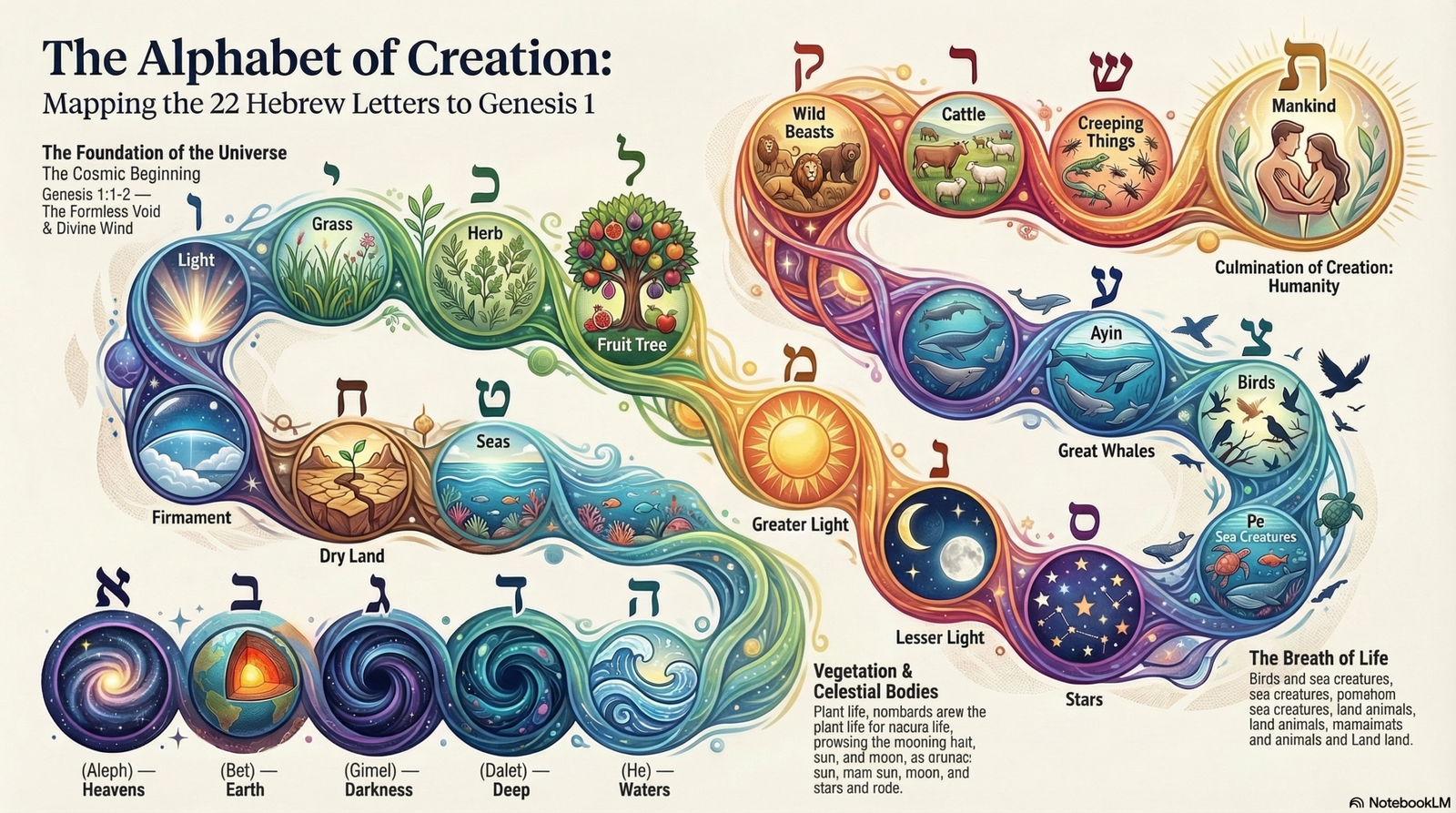
How does the first chapter of Genesis establish a direct mapping between the Hebrew alphabet and the physical world?
What mathematical constant is derived from the first verse of the Torah, and how is it calculated?
What is the significance of the patriarchs Adam and Jacob in relation to the Hebrew alphabet?
How is the Hebrew word for “Beginning” (Rasheed) derived from the lineage of the patriarchs?
How does the design of the Menorah (candlestick) described in Exodus 25 reflect the number of Hebrew letters?
In what way does the name of God (YHVH) relate to the number 22 when viewed through a Trinitarian lens?
Explain the mathematical concept of “partitioning” as it relates to the eight strokes of the Lord’s name.
What are the three categories into which the 22 Hebrew letters are divided by Jewish rabbis?
How does the structure of the Papal Cross mirror the division of the Hebrew alphabet?
What numerical patterns emerge when the names “Adonai,” “Yeshua,” and “Mushiya” are arranged in geometric circles?
Part II: Answer Key
How does the first chapter of Genesis establish a direct mapping between the Hebrew alphabet and the physical world? The sources state that there are exactly 22 distinct things created in Genesis 1, which correspond to the 22 letters of the Hebrew alphabet. This mapping begins with the letter Aleph representing the Heavens and concludes with the letter Tav representing Mankind.
What mathematical constant is derived from the first verse of the Torah, and how is it calculated? The constant Pi (\pi) is derived by taking the seven words of Genesis 1:1 and calculating the sum of the numerical values of their first letters, which equals 22. The ratio of the sum of the letters (22) to the number of words (7) results in 22/7, a well-known approximation of Pi.
What is the significance of the patriarchs Adam and Jacob in relation to the Hebrew alphabet? There are 22 patriarchs in the lineage from Adam to Jacob (Israel). Adam, the first patriarch, is associated with the first letter, Aleph, while Jacob, the 22nd patriarch, is associated with the final letter, Tav.
How is the Hebrew word for “Beginning” (Rasheed) derived from the lineage of the patriarchs? The word “Rasheed,” meaning “Beginning,” is formed using the names of five key patriarchs: Adam, Noah, Abraham, Isaac, and Jacob. This linguistic connection links the human lineage directly back to the “Bereshit” (Beginning) of the creation account.
How does the design of the Menorah (candlestick) described in Exodus 25 reflect the number of Hebrew letters? The Menorah is constructed with specific decorative elements, including 22 bowls. These 22 bowls are distributed across the central shaft and the six branches, mirroring the 22 letters of the Hebrew alphabet.
In what way does the name of God (YHVH) relate to the number 22 when viewed through a Trinitarian lens? The name YHVH is written with eight strokes, consisting of one initial point (Yod) and seven subsequent strokes. When mapped as three manifestations sharing the same starting point (1 + 7 + 7 + 7), the total equals 22, suggesting the entire alphabet is derived from the Creator’s name.
Explain the mathematical concept of “partitioning” as it relates to the eight strokes of the Lord’s name. In mathematics, a partition function determines the number of ways a single integer can be split into groups. The number 8, representing the strokes in the name of God, can be partitioned in exactly 22 different ways.
What are the three categories into which the 22 Hebrew letters are divided by Jewish rabbis? The letters are divided into “Three Mothers” (Aleph, Mem, and Shin), “Seven Doubles,” and “Twelve Simples.” This classification sums to 22 and is often represented geometrically in the “Tree of Life” or triangular patterns.
How does the structure of the Papal Cross mirror the division of the Hebrew alphabet? The Papal Cross consists of 22 squares or points of significance. It features 3 intersection points, 7 remaining points on the vertical line, and 12 points on the horizontal lines, mirroring the 3-7-12 division of the Hebrew letters.
What numerical patterns emerge when the names “Adonai,” “Yeshua,” and “Mushiya” are arranged in geometric circles? When these names are placed within a symmetrical geometric structure of 22 letters, the sum of the numerical values within any given circle remains constant. For “Adonai” the sum is 84, for “Yeshua” (Jesus) it is 81, and for “Mushiya” (Christ) it is 80.
Part III: Essay Questions
Instructions: Use the provided source context to develop comprehensive responses to the following prompts. (No answers provided).
The Language of Creation: Analyze the argument that the Hebrew alphabet serves as a “geometric and linguistic foundation” for the universe. How do the sources use the 22 created items in Genesis to support this claim?
Mathematical Supernaturalism: Discuss the significance of the appearance of Pi (\pi) and the numerical value of “Shaddai” (314) in the first verse of the Bible. What does the author imply about the nature of the Torah’s design based on these findings?
The Trinitarian Signature: Explain the complex relationship between the eight strokes of the Divine Name (YHVH), the 22 partitions of the number 8, and the 22-stroke Trinitarian mapping. How does this link the alphabet to the nature of the Creator?
Symbolic Symmetry in Sacred Objects: Compare the use of the number 22 in the design of the Menorah and the Papal Cross. How do these physical objects encode the “3-7-12” division of the Hebrew alphabet?
Patriarchal Correspondence: Examine the genealogical link between the 22 patriarchs and the 22 letters. How does the association of Adam and Jacob with Aleph and Tav provide a symbolic “Alpha and Omega” framework for the history of Israel?
Part IV: Glossary of Key Terms
Adonai: A Hebrew name for God meaning “Lord”; in geometric arrangements, it is associated with the numerical sum 84.
Aleph (א): The first letter of the Hebrew alphabet; associated with the “Heavens” in creation and the patriarch Adam.
Bereshit: The first word of the Torah, translated as “In the beginning.”
Doubles: A category of 7 Hebrew letters within the 22-letter system.
Hen (חן): The Hebrew word for “Grace,” which has a numerical value of 58.
Menorah: The seven-branched gold lampstand described in Exodus; features 22 decorative bowls.
Mothers: A category of 3 specific Hebrew letters: Aleph (א), Mem (מ), and Shin (ש).
Mushiya: The Hebrew word for “Christ”; associated with the numerical sum 80 in geometric letter patterns.
Partition Function: A mathematical process of splitting an integer into different combinations; the number 8 has 22 such partitions.
Pi (\pi): A mathematical constant (approx. 22/7 or 3.14); its values are linked to Genesis 1:1 and the name “Shaddai.”
Rasheed: A Hebrew word meaning “Beginning”; its letters are derived from the names of the key patriarchs.
Shaddai: A name for God meaning “Almighty”; its numerical value is 314, corresponding to the first three digits of Pi.
Simples: A category of 12 Hebrew letters within the 22-letter system.
Tav (ת): The 22nd and final letter of the Hebrew alphabet; associated with “Mankind” in creation and the patriarch Jacob.
YHVH (Yahuwah): The four-letter name of God; written with 8 strokes and fundamentally linked to the 22 letters of the alphabet.
Yeshua: The Hebrew name for “Jesus”; associated with the numerical sum 81 in geometric letter patterns.
https://optimalhealth.in/the-fruits-of-fear-and-worry/
https://biblenumbers101.com/pavitra-mandir-aur-sandook/
https://divinetruthofnumbers.com/22-secrets-of-the-hebrew-alphabet/