Author: Anguri John

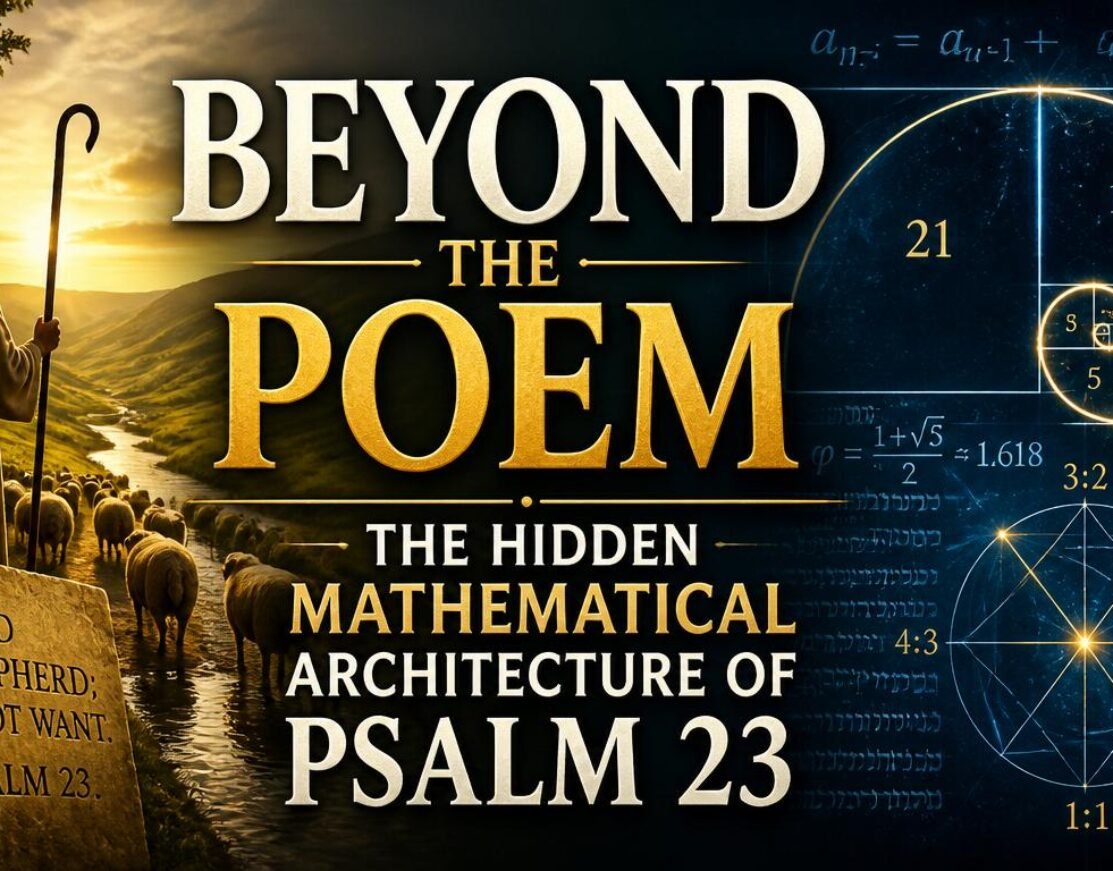
  • Beyond the Poem: The Hidden Mathematical Architecture of Psalm 23

    Beyond the Poem: The Hidden Mathematical Architecture of Psalm 23

    Beyond the Poem: The Hidden Mathematical Architecture of Psalm 23

    Psalm 23 is arguably the most recognisable fragment of
    literature in the human canon. To the casual reader, it offers a
    lyrical sanctuary of comfort; to the theologian, it stands as a
    monumental confession of faith. Yet, for those who peer
    beneath the surface of the Masoretic text, a more profound
    Reality emerges. There exists a sophisticated mathematical
    construct—a “Shepherd’s Code”—woven into the original
    Hebrew. This hidden architecture suggests that the spiritual
    The peace the Psalm provides is not merely a subjective
    psychological effect, but is crystallised in a universal precision
    that connects the human soul to the primordial laws of the
    cosmos.

    The Language where Letters are Numbers

    To the initiate, the Hebrew alphabet is not a mere set of
    phonetic markers, but a periodic table of divine elements. In
    In this sacred tongue, every character is simultaneously a
    numeral, meaning that the text of Psalm 23 is as much a
    ledger as it is a poem. This “Shepherd’s Code” is deciphered
    through Hebrew Gematria, utilising both Standard Gematria
    (the sum of letter values) and Ordinal Values (the placement of the letter within the 22-character alphabet).

    Beyond the Poem: The Hidden Mathematical Architecture of Psalm 23

    Psalm 23 is arguably the most recognizable fragment of literature in the human canon. To the casual reader, it offers a lyrical sanctuary of comfort; to the theologian, it stands as a monumental confession of faith. Yet, for those who peer beneath the surface of the Masoretic text, a more profound reality emerges. There exists a sophisticated mathematical construct—a “Shepherd’s Code”—woven into the original Hebrew. This hidden architecture suggests that the spiritual peace the Psalm provides is not merely a subjective psychological effect, but is crystallized in a universal precision that connects the human soul to the primordial laws of the cosmos.

    The Language where Letters are Numbers

    To the initiate, the Hebrew alphabet is not a mere set of phonetic markers, but a periodic table of divine elements. In this sacred tongue, every character is simultaneously a numeral, meaning that the text of Psalm 23 is as much a ledger as it is a poem. This “Shepherd’s Code” is deciphered through Hebrew Gematria, utilizing both Standard Gematria (the sum of letter values) and Ordinal Values (the placement of the letter within the 22-character alphabet).

    At the heart of this study lies the concept of Mispar ha-Panim, or “Inner Math.” Kabbalistic tradition posits that when two distinct phrases share a numerical value, they share a spiritual essence. This is rooted in the foundational belief that the Creator engineered the universe through Sefer, Sapher, and Sippur—Number, Writing, and Speech. In this worldview, mathematics is the objective “language of God,” providing an axiomatic foundation beneath the shifting tides of human emotion.

    The Divine DNA (The Number 26)

    The numerical signature of the Divine Name acts as the metaphysical anchor for the entire composition. The Tetragrammaton (YHVH), the unpronounceable four-letter name of God, possesses a numerical value of 26 (10 + 5 + 6 + 5). This is not a random sum; it is the “DNA” of the biblical text, appearing as a structural constant that dictates everything from the dimensions of the Tabernacle to the frequency of divine intervention.

    The opening phrase, Adonai Roi (יהוה רעי—“The Lord is my Shepherd”), pairs the value of 26 with 280 (the value of “Shepherd”). This union is more than a title; it represents a specific spiritual frequency. By anchoring the poem in the number 26, the text balances the Sephirot of Chesed (Mercy) and Gevurah (Strength), creating a harmonic resonance that allows the reader to navigate “the valley of the shadow” without fear.

    “The number 26 is the ‘DNA’ of the Bible, appearing as a structural constant in the dimensions of the Tabernacle and the frequency of the Divine Name throughout the text.”

    The Mathematical “Hinge” of the Soul

    The structural integrity of Psalm 23 is revealed in its boundaries: the original Hebrew consists of exactly 57 words. Within this closed system, there is a deliberate pivot point that shifts the reader’s relationship with the Divine. The first half of the Psalm utilizes the third person, talking about God (“He leads me,” “He restores my soul”), but the second half shifts to the second person, talking to God (“You are with me”).

    This transition occurs at the precise mathematical center of the work, the phrase Ki Atah Imadi (“For You are with me”). This central “hinge” consists of exactly seven letters. In the esoteric tradition, the number seven signifies completion and the sanctity of the Sabbath. By placing this seven-letter phrase at the core of the 57 words, the Architect of the text suggests that the transition from objective observation to personal intimacy is the ultimate point of spiritual rest. It is a mathematical initiation from a God who is “out there” to a Presence that is “here.”

    Geometric Alignment with Creation

    The “Shepherd’s Code” is not isolated; it is geometrically aligned with the very beginning of the biblical record. Through the Law of Prime Numbers, we find that the total gematria of key verses in the Psalm results in multiples of 37 and 73.

    These numbers are the fundamental “factors” of creation. The first verse of the Bible (Genesis 1:1) has a total numerical value of 2701, which is the product of exactly 37 and 73. These two numbers form a unique Hexagonal/Star geometry in mathematical theory. By integrating these same factors into the structure of Psalm 23, the text posits that the same “Architect” who coded the origin of the universe also coded the promise of “no want” (v. 1). The peace described in the poem is thus shown to be woven into the very fabric of reality.

    The Biological Synchronization of ’23’

    While the division of the Bible into numbered chapters was a later historical addition, the “Shepherd’s Code” suggests a divine synchronization regarding the number 23 itself. This number appears to bridge the gap between ancient scripture and the physical reality of the human vessel.

    Biologically, the human blueprint is contained within 23 pairs of chromosomes. Numerologically, 23 is associated with the “Royal Star of the Lion,” specifically the star Regulus, which has historically symbolized a protective influence and royal grace. This suggests that the 23rd Psalm is not merely a collection of words, but a frequency that resonates with the biological and celestial structures governing human life, providing a shield of protection that is written into our very cells.

    Conclusion: The Language of the Architect

    Psalm 23 functions as a dual masterpiece: it is a subjective poem of profound comfort and an objective mathematical map. By examining the Gematria and structural geometry of the original Hebrew, we encounter a text that is precisely engineered to reflect universal constants and biological realities.

    If the most famous words of comfort in history are built upon a foundation of mathematical certainty, what does that suggest about the design of our own lives? Perhaps our paths are not as random as they seem, but are being guided by a code that is as precise as it is merciful.

    https://biblenumbers101.com/is-the-bible-really-written-in-math-5/

    https://divinetruthofnumbers.com/7-ancient-hebrew-names-of-god/

  • 7 Ancient Hebrew Names of God That Reveal a Surprising Side of the Divine | The “Uni-Plural” Creator: The Mystery of Elohim

    7 Ancient Hebrew Names of God That Reveal a Surprising Side of the Divine | The “Uni-Plural” Creator: The Mystery of Elohim

    7 Ancient Hebrew Names of God That Reveal a Surprising Side of the Divine | The “Uni-Plural” Creator: The Mystery of Elohim

    To the believer, the many names of God revealed throughout the tapestry of Scripture are far more than mere labels; they are windows designed to throw light upon an infinite nature. Because God’s revelation of Himself is progressive, these names act as descriptive markers, spotlighting different facets of His personality and character as humanity’s capacity to understand Him grew. Yet, as we peer through these windows, we must acknowledge a scholarly humility: no single name, nor even the collective sum of them, could ever fully express the “unsearchable fullness” of His forgiveness, grace, and mercy toward mankind.

    By examining these ancient titles, we discover a Divine Being who is not a static monolith, but a dynamic Presence who meets the specific crises of the human condition with specific revelations of His nature.

    7 Ancient Hebrew Names of God That Reveal a Surprising Side of the Divine | The "Uni-Plural" Creator: The Mystery of Elohim
    7 Ancient Hebrew Names of God That Reveal a Surprising Side of the Divine | The “Uni-Plural” Creator: The Mystery of Elohim

    1. The “Uni-Plural” Creator: The Mystery of Elohim

    The name Elohim is the first name of God to grace the sacred page, appearing in the opening breath of Genesis: “In the beginning God…” It is a name that signifies the “putting forth of power,” identifying the Divine as the source of all life and the sovereign Creator of the universe. To the theological scholar, however, the name contains a deeper, more mysterious root: it signifies “to swear,” indicating a God who is under a covenant of an oath with Himself to perform His divine purposes.

    Elohim is fundamentally “uni-plural.” In Hebrew, it is a plural noun, yet it frequently governs singular verbs. We see this mystery articulated in the creation of humanity: “And God (Elohim) said, ‘Let Us make man in Our image’” (Genesis 1:26). Immediately following, the text shifts to the singular: “So God created man in His own image” (Genesis 1:27). This suggests a plurality in unity—an unqualified, unlimited energy that hints at the tri-unity of the Godhead from the very dawn of time.

    “It is agreed by most scholars that the name Elohim signifies the putting forth of power. He is the Being to whom all power belongs.”

    2. The Paradox of “Tender Power”: El Shaddai

    While the English “God Almighty” captures the raw strength of El Shaddai, it often misses the profound tenderness found in the Hebrew etymology. The word Shaddai is connected to a root signifying the female breast. This juxtaposition reveals a God who is both the “Mighty One” (El) and the “Succourer” and “Satisfier” of His people.

    Just as an infant finds total sustenance and security while nestling with its mother, El Shaddai is the One who is never weary of pouring forth His mercies. This name reveals a God who is more ready to give than His children are to receive—a Divine Parent who provides the milk of grace to sustain the weak.

    “The title Shaddai really indicates the fullness and riches of God’s grace… that He is never weary of pouring forth his mercies upon His people and that He is more ready to give than they are to receive.” — Cannon Girdlestone

    3. The God of the Outcast: El Roi

    One of the most intimate names of God was not first uttered by a patriarch or a priest, but by an Egyptian maidservant in the throes of despair. Banishment had driven Hagar into the wilderness of Shur. Beside a local sacred spring, she had a spiritual encounter so profound that she named the well Beer Lahai Roi—”the well of continuing to live after seeing God.”

    In her isolation, Hagar called Him El Roi: “Thou God seest me.” This name reveals God as the “God of vision.” It reminds us that the Living God does not look upon human suffering with a “cold eye of unconcern.” He looks with the tender care of a father. In the wilderness of our own lives, El Roi is the one who proves that we are never truly invisible to the Divine.

    4. Strategy Over Strength: Jehovah-Sabaoth and the Giant

    The name Jehovah-Sabaoth (The LORD of Hosts) carries a specific scholarly weight: it is a “revelation of failure.” Interestingly, this name is never found in the Pentateuch, Joshua, or Judges. It emerges only during Israel’s times of division and captivity, appearing 80 times in Jeremiah and 50 times in Zechariah. It signifies that when earthly power is exhausted, the “Hosts”—the heavenly armies of God—remain available to the elect.

    We see this most vividly in the valley of Elah. David, a youth refusing the unwieldy 160-pound coat of bronze mail offered by Saul, stood before Goliath. The giant was a marvel of human ingenuity, his spearhead alone weighing 20 pounds. Yet David understood that victory did not depend on man’s armor. Relying on “strategy over strength,” David invoked the name of the LORD of Hosts to bring heavenly power to a mundane battlefield.

    “Then David said to the Philistine, ‘You come to me with a sword, with a spear, and with a javelin. But I come to you in the name of the LORD of hosts, the God of the armies of Israel, whom you have defied.’”

    7 Ancient Hebrew Names of God That Reveal a Surprising Side of the Divine | The "Uni-Plural" Creator: The Mystery of Elohim
    7 Ancient Hebrew Names of God That Reveal a Surprising Side of the Divine | The “Uni-Plural” Creator: The Mystery of Elohim

    5. The Cost of Provision: Jehovah-Jireh

    Commonly translated as “The LORD will provide,” Jehovah-Jireh was originally a place name. It marks the spot on a mountain in the land of Moriah where Abraham was called to sacrifice his son, Isaac. There is a subtle theological shift in this narrative: it is Elohim who demands the sacrifice, but it is Jehovah who provides the substitutional ram.

    The “provision” Abraham saw that day—a ram caught in a thicket—was a future-tense promise. Abraham declared, “In the mount of the LORD it shall be seen,” pointing forward 2,000 years to the crucifixion of Christ. Scholars believe this very mountain is where Solomon’s Temple was eventually built, and near where Christ “suffered without the gate.” Here, Jehovah-Jireh shows us that sacrifice is the highest form of worship, and God is the one who “sees to it” that our deepest needs are met at His own expense.

    6. The Straight Path of Righteousness: Jehovah-Tsidkenu

    Jehovah-Tsidkenu means “The LORD our Righteousness.” The Hebrew root, Tsedek, means “to be stiff” or “straight,” providing a stark contrast to the crookedness of the human heart. There is a tragic irony here: the last king of Judah was named Zedekiah (“The righteousness of Jehovah”), yet he lived in absolute unrighteousness. In response, God revealed that He Himself would become the “Branch of righteousness” for His people.

    This righteousness is not earned; it is “imputed” or credited to the believer’s account. This divine standing acts as a “breastplate,” protecting the soul from the enemy’s accusations. The Scottish preacher Robert Murray McCheyne captured this transition from ignorance to grace in his moving hymn:

    “I once was a stranger to grace and to God, I knew not my danger, and felt not my load; Jehovah-Tsidkenu was nothing to me.”

    For McCheyne, as for us, the discovery of this name marks the moment our “guilty fears vanish” before the imputed perfection of God.

    7. The Final Syllable of Intimacy: Abba Father

    If we consider the names of God as spokes in a wheel, they all eventually merge into the centre hub: Abba Father. This title is the culmination of all Hebrew revelation. While the other names reveal majesty, unutterable awe, and power, Abba brings them into the warmth of a tender personal relationship.

    The name is composed of two simple syllables that even the youngest child can attempt. It is a bilingual bridge: Abba is Aramaic/Syriac, and Pater is Greek, allowing both Jew and Gentile to cry out with the same “devoted sense” of adoption. It represents the transition from the “spirit of bondage” to the freedom of a son or daughter.

    “The name ‘Father’ is indeed the sum of Christian revelation.” — B.F. Westcott

    A Call to Progressive Discovery

    These ancient names are not merely linguistic relics; they are invitations. They are the windows through which we glimpse the heart of the Infinite. Whether you find yourself in the wilderness with Hagar, facing a giant with David, or standing upon a mountain of sacrifice with Abraham, there is a name designed to meet your crisis.

    As you reflect on these descriptions, consider the “unwieldy armour” of self-reliance you may be carrying. Which of these “windows” do you need to look through today to see the Divine more clearly? Which spoke will you follow to find your way back to the Hub of the Father’s love?

    https://biblenumbers101.com/7-el-shaddai-jehovah-jireh-jehovah-adonai/

    https://divinetruthofnumbers.com/22-things-god-created-ingenesis-chapter1/

  • 22 Things God Created in Genesis Chapter 1

    22 Things God Created in Genesis Chapter 1

    22 Things God Created in Genesis Chapter 1

    Many biblical numerology researchers observe a symbolic pattern in Genesis Chapter 1. The chapter describes the creation of the universe in six days. When the acts of creation are counted carefully, a list of 22 created things appears.

    This number attracts attention because the Hebrew alphabet contains 22 letters, which Jewish mystical tradition connects with the creative speech of God.

    Genesis repeatedly states: “And God said…”. Creation happens through divine speech. Hebrew speech uses 22 letters. Some interpreters connect the 22 creations with the 22 Hebrew letters.

    Below is a commonly discussed breakdown.


    22 Things God Created in Genesis Chapter 1

    Day 1: Creation of Light

    1. Light – God created light and separated it from darkness (Genesis 1:3)
    2. Day – the light period receives the name Day (Genesis 1:5)
    3. Night – the darkness receives the name Night (Genesis 1:5)

    22 Things God Created in Genesis Chapter 1

    Day 2: Creation of the Sky

    1. Firmament / Sky – God forms the expanse dividing waters above and waters below (Genesis 1:6-8)

    22 Things God Created in Genesis Chapter 1

    Day 3: Creation of Earth and Vegetation

    1. Dry Land / Earth – land appears when waters gather (Genesis 1:9-10)
    2. Seas – the gathered waters become seas (Genesis 1:10)
    3. Grass – vegetation begins on the earth (Genesis 1:11)
    4. Herbs / Seed-bearing plants – plants producing seed (Genesis 1:11)
    5. Fruit Trees – trees producing fruit with seed (Genesis 1:11)

    22 Things God Created in Genesis Chapter 1

    Day 4: Creation of Heavenly Lights

    1. Sun – the greater light to rule the day (Genesis 1:16)
    2. Moon – the lesser light to rule the night (Genesis 1:16)
    3. Stars – the stars placed in the heavens (Genesis 1:16)

    22 Things God Created in Genesis Chapter 1

    Day 5: Creation of Sea and Air Creatures

    1. Sea Creatures – living creatures in the waters (Genesis 1:20-21)
    2. Great Sea Creatures / Great Whales – large creatures of the sea (Genesis 1:21)
    3. Birds – creatures flying in the sky (Genesis 1:20)

    22 Things God Created in Genesis Chapter 1

    Day 6: Creation of Land Animals and Humanity

    1. Cattle / Domestic Animals (Genesis 1:24)
    2. Creeping Creatures – small animals moving along the ground (Genesis 1:24)
    3. Wild Beasts – animals of the earth (Genesis 1:25)
    4. Man (Male) – created in the image of God (Genesis 1:27)
    5. Woman (Female) – created as humanity (Genesis 1:27)

    Additional Elements in the Creation Order

    Some scholars include additional domains created in Genesis 1.

    1. The Heavens – the cosmic realm above (Genesis 1:1)
    2. The Earth – the physical world (Genesis 1:1)

    The Symbolic Meaning of 22

    The number 22 appears important in several biblical structures.

    Examples:

    22 letters in the Hebrew alphabet
    22 sections in Psalm 119
    22 generations in some biblical genealogies
    22 paths in Kabbalistic tradition

    In Hebrew thought, letters represent creative speech. Genesis presents creation happening through spoken command.

    Example verses:

    Genesis 1:3
    “God said, Let there be light.”

    Genesis 1 repeats the phrase “God said” ten times, highlighting creation through divine words.


    Connection Between 22 Letters and Creation

    Jewish mystical teaching suggests:

    • God created the universe through sacred letters
    • Letters carry sound, number, and spiritual meaning
    • The 22 Hebrew letters form the building blocks of divine language

    Because Genesis describes creation through speech, many interpreters see a symbolic link between:

    22 created elements
    22 Hebrew letters


    Conclusion

    Genesis Chapter 1 describes the formation of the universe through ordered stages of creation. When the creative acts are counted, some interpreters observe 22 created elements, matching the 22 letters of the Hebrew alphabet.

    This observation supports a broader theme in biblical numerology. Creation unfolds through divine speech, and speech uses letters. In Hebrew tradition, the alphabet becomes a symbolic framework through which the Creator forms the world.

    The pattern invites readers to explore deeper connections between language, numbers, and the structure of the biblical text.

    https://divinetruthofnumbers.com/the-menorah-pattern-sefirot-7-10-22/

    https://biblenumbers101.com/yhwh-3-parmeshwar-ka-naam/

  • The Menorah Pattern, Sefirot, and the Structure of the Hebrew Alphabet | The Menorah and the Number 7 | The 10 Sefirot | The 22 Hebrew Letters in Sefer Yetzirah

    The Menorah Pattern, Sefirot, and the Structure of the Hebrew Alphabet | The Menorah and the Number 7 | The 10 Sefirot | The 22 Hebrew Letters in Sefer Yetzirah

    The Menorah Pattern, Sefirot, and the Structure of the Hebrew Alphabet | The Menorah and the Number 7 | The 10 Sefirot | The 22 Hebrew Letters in Sefer Yetzirah

    Jewish mystical teaching connects three systems.

    • The Menorah with 7 branches
    • The Ten Sefirot of divine emanation
    • The 22 Hebrew letters

    This structure appears in Kabbalah and the ancient text Sefer Yetzirah. These systems describe how divine energy flows into creation.


    The Menorah Pattern, Sefirot, and the Structure of the Hebrew Alphabet
    The Menorah Pattern, Sefirot, and the Structure of the Hebrew Alphabet

    The Menorah and the Number 7

    The Menorah stood in the Holy Place of the Tabernacle and later in the Temple.

    Biblical reference
    Exodus 25:31-37

    Key features:

    7 branches
    Central shaft with six side branches
    • Made from one piece of gold

    Symbolic meaning in mystical interpretation:

    • 7 branches represent seven spiritual channels
    • Central lamp represents divine light
    • Side lamps represent manifested wisdom

    Many scholars connect the seven branches with the seven double Hebrew letters.


    The 10 Sefirot

    In Kabbalah, creation flows through the Ten Sefirot. These are divine attributes or channels.

    The ten Sefirot:

    1. Keter – Crown
    2. Chokhmah – Wisdom
    3. Binah – Understanding
    4. Chesed – Mercy
    5. Gevurah – Strength
    6. Tiferet – Beauty
    7. Netzach – Victory
    8. Hod – Glory
    9. Yesod – Foundation
    10. Malkhut – Kingdom

    Meaning:

    • These represent stages of divine manifestation
    • Energy flows from Keter to Malkhut
    • Creation unfolds through these channels

    The 22 Hebrew letters connect these Sefirot through spiritual pathways.


    The Menorah Pattern, Sefirot, and the Structure of the Hebrew Alphabet
    The Menorah Pattern, Sefirot, and the Structure of the Hebrew Alphabet

    The 22 Hebrew Letters in Sefer Yetzirah

    According to Sefer Yetzirah, the Hebrew alphabet is divided into three groups.

    Total letters = 22

    Structure:

    3 Mother letters
    7 Double letters
    12 Simple (Ordinary) letters

    This system describes the spiritual structure of creation.


    The Three Mother Letters

    Mother letters:

    Aleph (א)
    Mem (מ)
    Shin (ש)

    Meaning in Sefer Yetzirah:

    • Aleph represents air
    • Mem represents water
    • Shin represents fire

    These correspond to the three primary elements of creation.

    Symbolic meaning:

    • Fire
    • Water
    • Air

    These elements form the basic forces of the universe.


    The Seven Double Letters

    Double letters:

    Bet (ב)
    Gimel (ג)
    Dalet (ד)
    Kaf (כ)
    Pe (פ)
    Resh (ר)
    Tav (ת)

    They are called double letters because they can produce two sounds.

    Example

    Bet
    • B sound
    • V sound

    Kabbalah associates these seven letters with:

    Seven days of creation
    Seven classical planets
    Seven branches of the Menorah

    Planets traditionally linked:

    • Saturn
    • Jupiter
    • Mars
    • Sun
    • Venus
    • Mercury
    • Moon


    The Twelve Ordinary Letters

    The remaining letters form the 12 simple letters.

    These are:

    • He (ה)
    • Vav (ו)
    • Zayin (ז)
    • Het (ח)
    • Tet (ט)
    • Yod (י)
    • Lamed (ל)
    • Nun (נ)
    • Samekh (ס)
    • Ayin (ע)
    • Tsade (צ)
    • Qof (ק)

    In mystical interpretation, these correspond with:

    12 months of the Hebrew calendar
    12 tribes of Israel
    12 constellations

    This shows the connection between:

    • time
    • human history
    • cosmic cycles


    Numerical Pattern of the Hebrew Alphabet

    Gematria assigns numerical values.

    Examples:

    Aleph = 1
    Bet = 2
    Gimel = 3
    Dalet = 4
    He = 5

    The system continues until:

    Tav = 400

    This system allows hidden numerical meanings inside Hebrew words.

    Example:

    Chai (Life)

    Chet = 8
    Yod = 10

    Total = 18

    Because of this, the number 18 symbolises life in Jewish culture.


    The Connection Between the Menorah, Letters, and Creation

    Kabbalistic interpretation connects the systems.

    Structure:

    Menorah = 7 branches

    Alphabet structure:

    • 3 Mother letters
    • 7 Double letters
    • 12 Simple letters

    Total = 22 letters

    Mystical meaning:

    • God created the universe through speech
    • Speech formed through letters
    • Letters operate through numerical patterns

    This idea appears in Psalm 33:6

    “By the word of the Lord the heavens were made.”


    Conclusion

    The Hebrew alphabet functions as more than a writing system.

    Mystical tradition sees it as a framework of creation.

    Key structure:

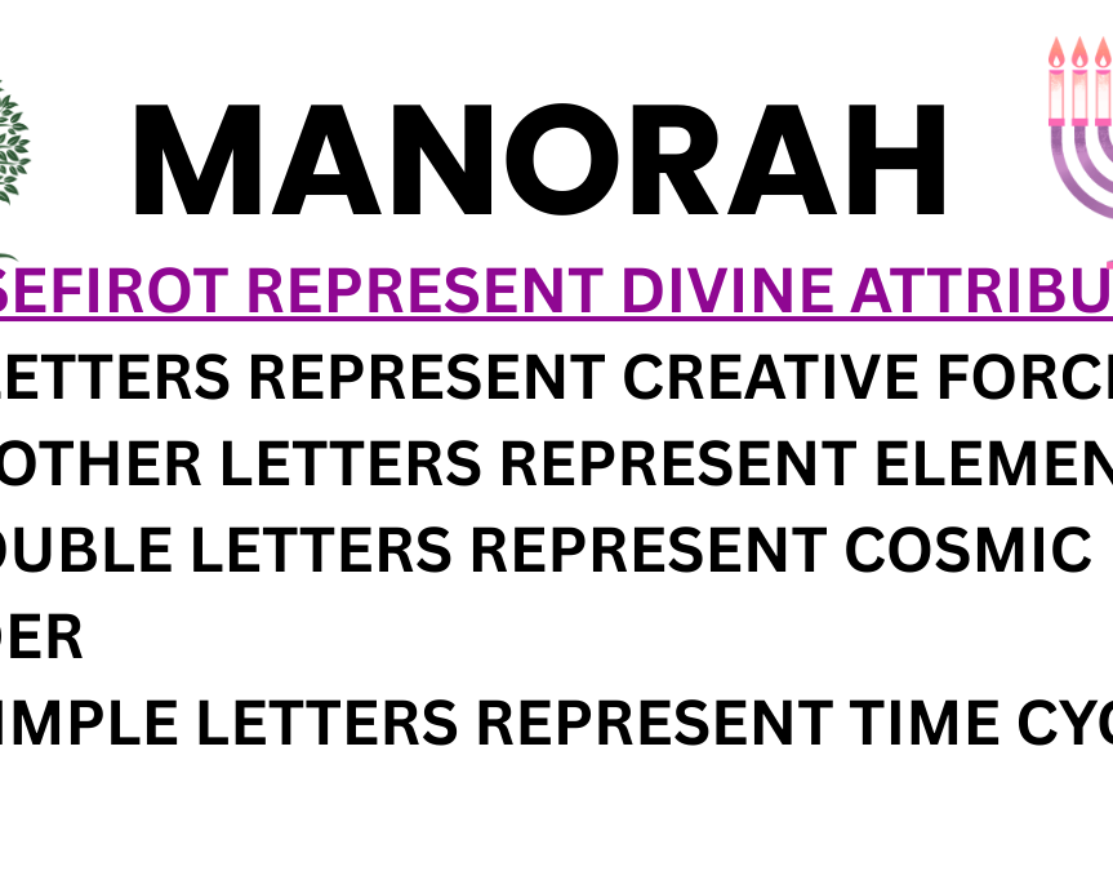
    10 Sefirot represent divine attributes
    22 letters represent creative forces
    3 Mother letters represent elements
    7 Double letters represent cosmic order
    12 Simple letters represent time cycles

    Together, they form a symbolic map of how divine wisdom flows into the universe.

    https://biblenumbers101.com/aleph-se-tav-tak/

    https://divinetruthofnumbers.com/divine-name-revealed-yhwh-vs-jehovah/

  • The Divine Name Revealed: A Historical and Linguistic Study of YHWH, Jehovah, and Yahweh | The Echo of the Divine Name: A Synthesis of Its Historical Pronunciation and Suppression

    The Divine Name Revealed: A Historical and Linguistic Study of YHWH, Jehovah, and Yahweh | The Echo of the Divine Name: A Synthesis of Its Historical Pronunciation and Suppression

    The Divine Name Revealed: A Historical and Linguistic Study of YHWH, Jehovah, and Yahweh | The Echo of the Divine Name: A Synthesis of Its Historical Pronunciation and Suppression

    The Divine Name Revealed: A Historical and Linguistic Study of YHWH, Jehovah, and Yahweh

    Meta Description
    What is the meaning of the divine name YHWH? Explore the history, pronunciation debates, and suppression of the sacred name of God in the Bible, including the forms Jehovah and Yahweh.


    The Divine Name Revealed

    A Historical and Linguistic Study of YHWH, Jehovah, and Yahweh

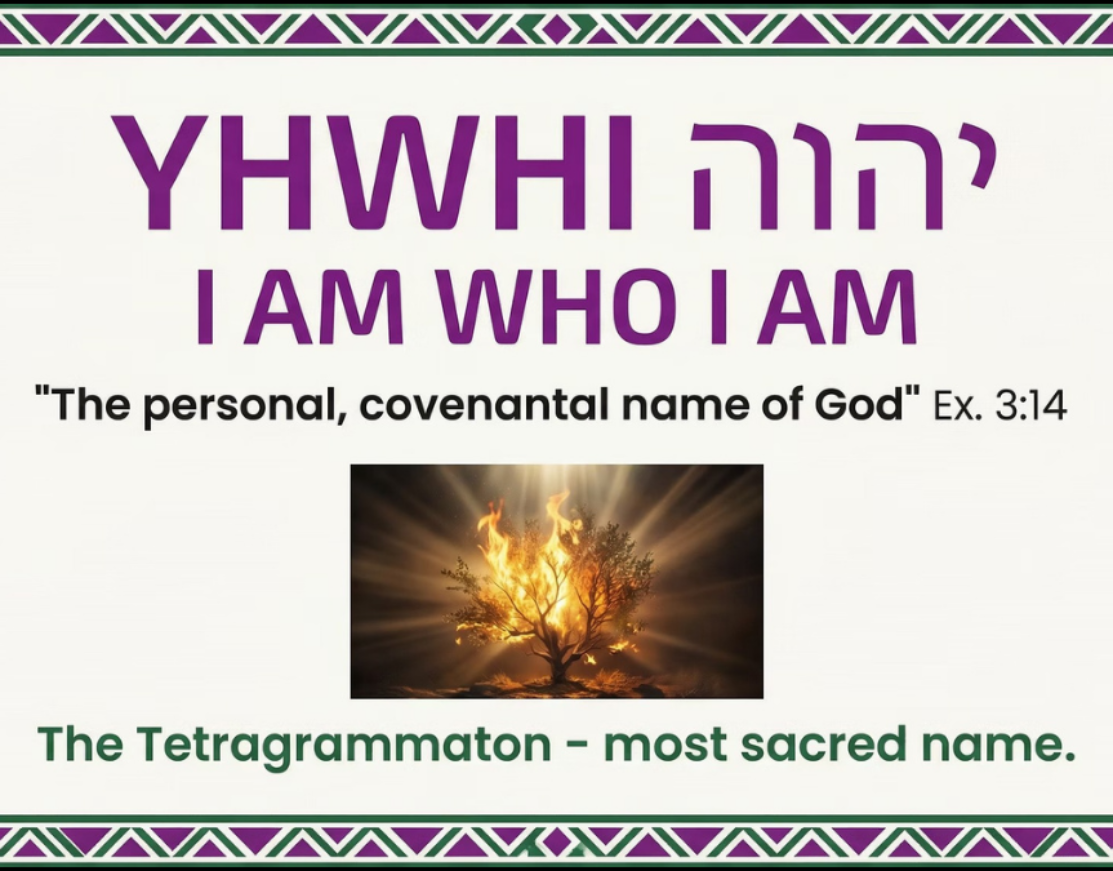
    In the Hebrew Bible, the sacred name of God is written as YHWH, a four-letter name known as the Tetragrammaton. This name appears thousands of times in the Hebrew Scriptures and represents the personal covenant name of the Creator.

    Originally, this name was spoken openly in ancient Israel. Over time, historical pressures, religious reverence, and linguistic changes led to the gradual suppression of its pronunciation. As a result, alternative forms such as Jehovah and Yahweh developed in later traditions.

    This article explores the historical use, linguistic meaning, and later transformation of the divine name.


    1. Early Use of the Divine Name

    In ancient Israel, the name YHWH was not hidden or secret. It was used in prayers, blessings, oaths, and daily greetings.

    Reference
    Book of Exodus 3:14–15

    In this passage, God revealed His identity to Moses:

    “I AM WHO I AM.”

    After this declaration, God instructed Moses to tell the Israelites that YHWH had sent him.

    Key characteristics of the name

    • Appears about 6,800 times in the Hebrew Bible
    • Represents God’s personal identity
    • Intended to be remembered and spoken across generations

    Social usage

    The name was even used in ordinary greetings.

    Example
    Book of Ruth 2:4

    Boaz greeted the workers in the field saying:

    “The Lord be with you.”

    In Hebrew, this greeting originally included the divine name.


    2. Linguistic Meaning of YHWH

    Scholars generally connect YHWH with the Hebrew verb “to be.”

    The name reflects three dimensions of existence:

    • He was
    • He is
    • He will be

    Thus, the divine name expresses the idea of eternal existence.

    It describes God as the self-existing and eternal One.


    3. Suppression of the Divine Name

    The open use of the divine name gradually changed during the Roman period.

    After the destruction of Jerusalem in 70 AD and the later Bar Kokhba revolt (132–135 AD), Roman authorities imposed strict controls on Jewish religious practices.

    Under Emperor Hadrian, several Jewish traditions were restricted:

    • Circumcision
    • Sabbath observance
    • Public expression of Jewish religious identity

    These pressures contributed to the growing reluctance to pronounce the divine name publicly.


    4. Rabbinic Tradition and Silence

    By the third century, Jewish rabbinic tradition had developed strict caution regarding the pronunciation of the name.

    According to references in the
    Talmud (Kiddushin 71a), the correct pronunciation of the name was transmitted only to select disciples.

    Protective traditions included

    • Teaching the pronunciation only occasionally
    • Ritual purification before instruction
    • Limiting the knowledge to trusted scholars

    One reason for this restriction was to prevent the misuse of the divine name in magical practices.


    5. Translation Changes

    When the Hebrew Scriptures were translated into Greek in the Septuagint, translators often replaced YHWH with the Greek title Kyrios, meaning “Lord.”

    Later Latin translations used Dominus, also meaning “Lord.”

    This shift gradually replaced the personal name of God with a title of authority in many biblical translations.


    6. The Pronunciation Debate: Jehovah vs Yahweh

    During the Middle Ages, Jewish scholars known as the Masoretes preserved the Hebrew text by adding vowel marks.

    This process contributed to two widely discussed pronunciations.

    Jehovah

    The form Jehovah developed by combining the consonants YHWH with the vowel signs associated with the word Adonai (Lord).

    Yahweh

    Many modern scholars believe the ancient pronunciation may have been Yahweh, based on linguistic reconstruction and historical references.

    The exact original pronunciation remains uncertain.


    7. The Spiritual Significance of the Name

    In Hebrew thought, a name represents character and identity.

    Therefore, the divine name reveals the nature of God.

    Scripture emphasizes the power of God’s name.

    Reference
    Book of Proverbs 18:10

    “The name of the Lord is a strong tower; the righteous run to it and are safe.”


    Conclusion

    The divine name YHWH holds a central place in biblical history and theology. It was once spoken openly in ancient Israel but gradually became hidden due to reverence, historical pressures, and linguistic changes.

    Later forms such as Jehovah and Yahweh reflect attempts to understand and pronounce the sacred name.

    Studying the divine name helps readers understand the language, history, and spiritual message of the Bible more deeply.

    The Echo of the Divine Name: A Synthesis of Its Historical Pronunciation and Suppression


    1. The Primordial Usage: From Public Greeting to Divine Command

    In the foundational stratigraphy of the Hebrew Bible, the Tetragrammaton—the four-letter Name of the Creator—functions not as an esoteric secret, but as the pulsating heart of Israelite identity. According to the ontological revelation in Exodus 3:14-15, the Name was established as a permanent designation. While the declaration Ehyeh Asher Ehyeh (“I am that I am” or “I will be what I will be”) provided the existential framework, the specific Name (Y-H-V-H) was explicitly commanded as a “memorial” (zikir) for all generations.

    Philologically, the root of zikir denotes a “mention” or a calling out; thus, the Name was intended to be a vocalized anchor in prayer, legal oaths, and daily discourse. This mandate is reflected in the sheer frequency of the Name: the Tetragrammaton appears 6,827 times in the Hebrew Bible (6,828 in the Leningrad Codex), dwarfing the title Adonai (Lord), which appears approximately 434 times.

    The linguistic weight of the Name is rooted in a tripartite existential synthesis. It is a contraction of the verbal roots Hayah (He was), Hoveh (He is), and Yi’yeh (He will be). By weaving these tenses into a single designation, the Name defines the Divine as the one who possesses eternal, continuous existence. This era of transparency is characterized by the use of the Name in common social interactions, bridging the gap between the celestial and the terrestrial.

    The Name in Ancient Social Interaction

    AspectBiblical PrecedentTheological MandateLinguistic Function
    Social ContextCommon greetings utilized by Boaz (“Yehovah be with you”) and the Angel’s address to Gideon.Establishing a specific, personal identity amidst the myriad deities of the Egyptian and Canaanite pantheons.Utilization as a zikir (mention/calling out), indicating the Name was designed for vocalization.
    Linguistic RootManifestation of Divine presence in immediate circumstances (harvest, battle).Contraction of Hayah, Hoveh, and Yi’yeh—defining the “Self-Existent One.”Explicitly designated as a “memorial for generation to generation,” intended for perpetual usage.

    This period of vocal transparency eventually succumbed to a complex trajectory of silence, as external geopolitical pressures and internal theological shifts forced the Name into a state of systematic occlusion.

    2. External Suppression: The Hadrianic Persecutions and Roman Policy

    The transition from the vocalization of the Name to its suppression was catalyzed by the catastrophic deterioration of Roman-Jewish relations following the destruction of the Second Temple in 70 AD and the subsequent Bar Kokhba Revolt (132–135 AD). In the eyes of the Roman administration, the Name became a flashpoint for political subversion. While the “Jewish exemption” had previously allowed Judeans to sacrifice for the Emperor to their own God rather than to the Emperor as a god, this tolerance was rescinded under the reign of Emperor Hadrian.

    The Hadrianic Decrees represented a state-sponsored program of forced assimilation. Hadrian sought to abolish the distinctive markers of Judaism—circumcision, Sabbath observance, and the public mention of the Name—to dissolve the religious identity that fueled Jewish resistance.

    The failure of the Bar Kokhba Revolt, which many had hoped would usher in a messianic era, solidified a Rabbinic pivot toward self-censorship. The expected restoration of the Name was deferred to a future “World to Come” (Olam Ha-Ba), where the Messiah would reign and the Name would finally be “read as it is written.” This convergence of Roman state violence and messianic disappointment effectively drove the Name into a ritualized silence.

    3. Internal Proscription: The “Conspiracy of Silence” and the Talmudic Debate

    Internal Jewish mechanisms of protection soon mirrored external Roman prohibitions. While the sage Hanina ben Teradion was martyred by the Romans for “pronouncing the Name according to its letters,” the formal “Conspiracy of Silence” was a 3rd-century transition led by figures such as Rama bar Bar-Khana. This period saw the mandate that the Name be transmitted only in secret, once every seven years, to ensure that the correct vocalization was preserved without being exposed to Roman detection or common profanation.

    The primary Rabbinic justification for this proscription was the prevention of “the abuse of the Name in magic.” Evidence from the Mishna and Talmud (Kiddushin 71a) reveals that the Name was being utilized in gnostic incantations and unauthorized healing rituals. To safeguard the Name, it was relegated to an elite cycle of transmission involving rigorous purification:

    1. Seven-Year Transmission Cycle: Sages transmitted the vocalization to select disciples once every seven years.
    2. Purification Rituals: Preparation involved fasting and immersion in a mikveh (ritual bath).
    3. Ritual Attire: Participants wore white clothing to symbolize theocratic purity.
    4. Esoteric Vocalization: The Name was often whispered over water or transmitted via mnemonics such as SHA-KO (representing the vowels Schwa, Cholem, and Kamatz) to preserve the precise nikud (vocal points) while avoiding public utterance.

    This retreat from the public sphere necessitated textual surrogates, leading to a permanent linguistic shift in the transmission of sacred manuscripts.

    4. The Linguistic Shift: From Paleo-Hebrew to Greek and Latin Surrogates

    The translation of the Old Testament into the Septuagint (LXX) served as the primary vehicle for the Name’s transformation in the Hellenistic world. Early manuscripts of the Septuagint—as seen in discoveries like 4Q120—often retained the Tetragrammaton in Paleo-Hebrew characters, a visual “stop sign” amidst the surrounding Greek text. However, as Christian scribes unfamiliar with the Hebrew script began copying these texts, paleographic corruptions occurred.

    The most notable instance is the “Pi-Pi” error. Because the Paleo-Hebrew He (ה) visually resembles the Greek Pi (Π), and the Yod (י) or Vav (ו) can be mistaken for an Iota (Ι), Greek scribes frequently transcribed the Tetragrammaton as “ΠΙΠΙ.” Eventually, these visual anomalies were replaced with theocratic elisions: the titles Kyrios (Lord) and Dominus.

    The Impact of Theological Occlusion

    • Erosion of Specificity: The replacement of a unique personal Name with the title “Lord” obscured the specific identity of the God of Israel, making Him indistinguishable from generic deities like the Canaanite Baal (which also means “Lord”).
    • Distance vs. Intimacy: The shift from a Name to a title of authority fundamentally altered the perceived relationship between the Divine and the devotee, favoring an exalted mystery over a present, breathing reality.
    • Downstream Obscurity: These Greek and Latin traditions created what Martin Luthur described as a “downstream puddle” of translation, clouding the original Hebrew for Western scholars and leading to centuries of academic friction.

    5. Masoretic Preservation and the Great Pronunciation Debate

    The codification of the oral tradition fell to the Masoretes (c. 600 AD), who developed the system of nikud (vowel points) found in the Aleppo and Leningrad Codices. While they utilized the “Qere/Ketiv” system (written as Y-H-V-H but read as Adonai), the internal evidence of the manuscripts challenges 19th-century scholarship.

    The “Stupid Christian Hypothesis,” championed by Wilhelm Gesenius, asserted that the vowels for Yehovah were merely the vowels of Adonai transposed onto the Tetragrammaton by ignorant Christians. However, a manuscript specialist must note that Peter Galatinus (1518) explicitly acknowledged that Jews read the Name as Adonai; the hypothesis was not based on Galatinus’s ignorance, but on a modern misrepresentation of his work. Furthermore, the linguistic evidence is definitive: the vowels of Adonai (Chateph Patach-Cholem-Kamatz) do not match those of Yehovah (Schwa-Cholem-Kamatz). If the scribes had intended a simple transposition, the Yod would require a Chateph Patach to match the Aleph in Adonai. The presence of the Schwa in over 2,441 manuscripts suggests the vowels are inherent to the Name itself.

    The Yahweh vs. Yehovah Debate: A Battle of Stems

    The “Yahweh” Case (Genebrard, 1699)The “Yehovah” Case (Masoretic Evidence)
    Based on a 5th-century report by Theodoret of Cyrus regarding a Samaritan pronunciation (Yave).Based on over 2,441 biblical manuscripts (e.g., Aleppo Codex) utilizing the Schwa-Cholem-Kamatz nikud.
    Relies on the Hiphil (Causative) stem: “He who causes to be” (Creator).Aligns with the Kal (Simple) stem: “He who was, is, and will be” (Existential).
    Grounded in Gnostic/Greek magical papyri and Samaritan sources (who themselves often used the surrogate “Shema”).Supported by 16+ historical Rabbis (e.g., Menachem Sione, 14th century) who preserved the vowels as a secret tradition.

    The “Yahweh” reconstruction, while popular in modern academia, relies on the shaky foundation of a Samaritan report centuries after the Samaritans had ceased pronouncing the Name. Conversely, the “Yehovah” vocalization aligns with the existential theology of Exodus 3:14.

    6. Synthesis and Historical Conclusion: The Character of the Name

    The journey of the Divine Name—from the common greetings of the harvest fields to the ritualized silence of the Talmudic era—reflects a profound shift in Hebraic philosophy. In Semitic thought, Shem (Name) is synonymous with “Character.” The journey from vocalization to silence reflects a shift in the perceived character of the Divine: from a present, breathing reality to an exalted, hidden mystery. This is even reflected in the “Breath of God” theory, which suggests that Y-H-V-H mimics the sound of respiration (Yod-He/Inhale, Vav-He/Exhale), implying that the Name is woven into the very DNA of existence.

    Three Critical Takeaways

    1. Philological Precision: Scholars must move beyond the “Stupid Christian Hypothesis” and recognize the technical nikud evidence (the Schwa vs. Chateph Patach) that supports the Masoretic vocalization.
    2. Theocratic Integrity: The replacement of a personal name with the title “Lord” in Western translations constitutes a theological occlusion that masks the specific, covenantal identity of the Creator.
    3. Ethical Transmission: The historical record shows the Name was suppressed as a temporary measure against magic and Roman persecution, not as an eternal erasure.

    The historical trajectory of the Name suggests that the current movement toward restoration is not a modern innovation, but a return to the primordial zikir. As envisioned in the prophetic conclusion of Zechariah 14:9, the era of surrogates and elisions is destined to end: “In that day shall there be one Lord, and His name one.” The suppression of the Name was a strategic withdrawal; its restoration signifies the return of the Divine Character to the public consciousness of the world.


    FAQs

    1. What does YHWH mean?

    YHWH is the four-letter Hebrew name of God, often connected with the meaning “He who is” or “the Eternal One.”

    2. How many times does YHWH appear in the Bible?

    It appears approximately 6,800 times in the Hebrew Scriptures.

    3. Are Jehovah and Yahweh the same?

    Both are attempts to vocalize the same Hebrew name YHWH, though they come from different linguistic traditions.

    4. Why did Jews stop pronouncing the name?

    Out of reverence for its holiness and to prevent misuse, the name gradually stopped being spoken publicly.

    5. Why do many English Bibles use “Lord” instead?

    Translators followed the tradition of replacing YHWH with the title “Lord,” reflecting the ancient Greek and Latin translation.

    https://divinetruthofnumbers.com/ark-of-the-covenant/

    https://biblenumbers101.com/bible-ke-5-krantikari-rahasya/

  • Deeper Secrets of the Hebrew Alphabet, Genesis 1:1, and the Number Pattern of 22

    Deeper Secrets of the Hebrew Alphabet, Genesis 1:1, and the Number Pattern of 22

    Deeper Secrets of the Hebrew Alphabet, Genesis 1:1, and the Number Pattern of 22

    In Hebrew mystical study, the alphabet contains 22 sacred letters. Jewish tradition, Kabbalah, and biblical numerology link these letters with the structure of creation, kingship, and divine order.

    Genesis 1:1 shows one of the most studied numerical structures in Scripture.

    Hebrew text of Genesis 1:1

    בראשית ברא אלהים את השמים ואת הארץ

    Transliteration
    Bereshit Bara Elohim Et Hashamayim Ve’et Haaretz

    This verse holds several numerical patterns connected with the 22 Hebrew letters.


    1. The Structure of Genesis 1:1

    Genesis 1:1 contains:

    7 Hebrew words
    28 Hebrew letters
    • 28 equals 4 × 7

    Seven represents divine perfection.

    Word structure:

    בראשית – Bereshit
    ברא – Bara
    אלהים – Elohim
    את – Et
    השמים – Hashamayim
    ואת – Ve'et
    הארץ – Haaretz

    Seven words show the divine order of creation.


    2. The Hidden Pattern of the Number 22

    Although Genesis 1:1 contains 28 letters, scholars notice something interesting.

    The verse contains all major building blocks of the Hebrew alphabet system, which has 22 letters.

    The 22 letters symbolise:

    • 22 creative forces
    • 22 spiritual paths
    • 22 foundations of divine speech

    According to the mystical book Sefer Yetzirah, God created the world through 22 letters.


    3. Seven Words Represent the Seven Days of Creation

    The seven words of Genesis 1:1 correspond symbolically with the seven days of creation.

    Example interpretation used in mystical tradition:

    Word 1 – Heaven and earth created in potential
    Word 2 – The act of creation begins
    Word 3 – Divine authority of Elohim
    Word 4 – The object marker, linking heaven and earth
    Word 5 – The heavens
    Word 6 – Connection between realms
    Word 7 – The Earth

    Seven form the complete cycle of creation.


    4. The 22 Paths of Wisdom

    In Kabbalah, the 22 Hebrew letters correspond to 22 spiritual paths.

    These paths connect the ten sefirot in the mystical Tree of Life.

    Structure:

    • 10 divine emanations
    • 22 connecting paths
    • Total spiritual structure: 32 paths of wisdom

    These 22 paths represent channels through which divine energy flows into creation.


    5. The 22 Generations from Adam to Jacob

    Some biblical scholars observe a generational pattern.

    From Adam to Jacob, the genealogy produces 22 generations in some traditional calculations.

    These correspond symbolically with the 22 Hebrew letters.

    Meaning:

    Human history unfolds through the same number system used in divine language.


    6. The Mystery of 22 Kings

    The Old Testament lists the kings of Israel and Judah.

    Some numerological interpretations highlight a pattern of 22 royal rulers before major national collapse events.

    The number symbolises:

    • authority
    • completion of a royal cycle
    • transition of divine judgment

    In Hebrew symbolism, 22 often marks a full cycle of authority or covenant leadership.


    7. The Hidden Message in the Word “Bereshit”

    The first word of the Bible:

    בראשית (Bereshit)

    Gematria calculation:

    ב = 2
    ר = 200
    א = 1
    ש = 300
    י = 10
    ת = 400

    Total = 913

    Some scholars break the word into hidden phrases:

    ברא שית – “He created six”
    This hints at six days of creation.


    8. The Central Word of Creation

    In Genesis 1:1, the central word is:

    את (Aleph + Tav)

    Aleph = first Hebrew letter
    Tav = last Hebrew letter

    Meaning:

    Aleph to Tav represents the complete alphabet.

    Symbolically:

    God created everything from the beginning to the end.

    This concept later appears in the New Testament statement:

    “I am the Alpha and Omega.”


    9. The Pattern of 7 and 22 Together

    Hebrew mystical studies often combine the numbers 7 and 22.

    Example:

    • 7 days of creation
    • 22 letters of divine speech

    Creation operates through:

    Time cycle (7)
    Language structure (22)

    Together, they form the mathematical design of creation.


    10. The Numerical Structure of the Creation Week

    In Genesis chapter 1:

    • The phrase “God said” appears 10 times
    • The number 7 repeats many times
    • The alphabet structure connects with 22 letters

    This reveals a layered numerical pattern:

    • 7 = completion
    • 10 = divine law
    • 22 = creative language


    11. The 22 Letters and Human Speech

    Jewish tradition teaches that human speech uses the same alphabet through which God created the universe.

    Three groups exist in the Hebrew alphabet:

    Mother letters – 3
    Double letters – 7
    Simple letters – 12

    Total = 22 letters

    These represent:

    • elements of creation
    • cosmic forces
    • human expression


    12. The Alphabet Hidden in Scripture

    Many Psalms follow the Hebrew alphabet pattern.

    Example:

    Psalm 119.

    It contains:

    22 sections
    • Each section is linked with a Hebrew letter
    • Each section contains 8 verses

    Total verses = 176

    This structure reflects the sacred alphabet system.


    Conclusion

    The Hebrew alphabet forms a numerical and spiritual framework behind the Bible.

    Important patterns include:

    22 Hebrew letters representing divine speech
    7 words in Genesis 1:1 symbolising creation
    Aleph to Tav representing completeness
    22 spiritual paths in Kabbalah
    • Alphabet structures appearing in Psalms and other texts

    These patterns suggest the Bible contains linguistic, symbolic, and numerical design, connecting language, mathematics, and theology.

    https://www.youtube.com/playlist?list=PLWt-6CmVZm9THVEfNwZwj2_gZ3itxdT_a

    https://divinetruthofnumbers.com/jesus-in-genesis-11/

  • The Divine Geometry of the 22 Hebrew Letters: A Comprehensive Study Guide

    The Divine Geometry of the 22 Hebrew Letters: A Comprehensive Study Guide

    The Divine Geometry of the 22 Hebrew Letters: A Comprehensive Study Guide

    This study guide explores the mathematical, linguistic, and spiritual significance of the 22 letters of the Hebrew alphabet as presented in the provided research materials. It examines the recurring appearance of the number 22 in biblical creation, genealogy, and sacred geometry.

    Part I: Short-Answer Quiz

    Instructions: Answer the following questions in 2–3 sentences based on the provided source context.

    How does the first chapter of Genesis establish a direct mapping between the Hebrew alphabet and the physical world?
    What mathematical constant is derived from the first verse of the Torah, and how is it calculated?
    What is the significance of the patriarchs Adam and Jacob in relation to the Hebrew alphabet?
    How is the Hebrew word for “Beginning” (Rasheed) derived from the lineage of the patriarchs?
    How does the design of the Menorah (candlestick) described in Exodus 25 reflect the number of Hebrew letters?
    In what way does the name of God (YHVH) relate to the number 22 when viewed through a Trinitarian lens?
    Explain the mathematical concept of “partitioning” as it relates to the eight strokes of the Lord’s name.
    What are the three categories into which the 22 Hebrew letters are divided by Jewish rabbis?
    How does the structure of the Papal Cross mirror the division of the Hebrew alphabet?
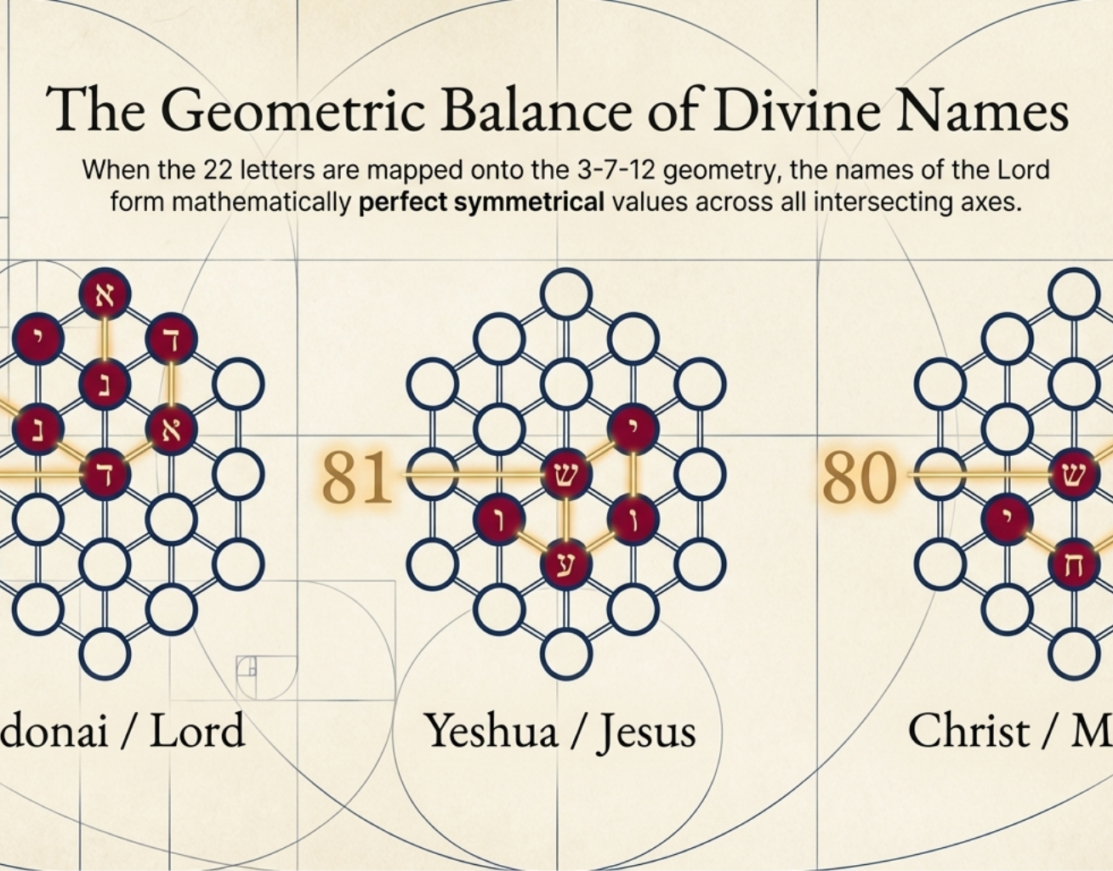
    What numerical patterns emerge when the names “Adonai,” “Yeshua,” and “Mushiya” are arranged in geometric circles?

    The Divine Geometry of the 22 Hebrew Letters: A Comprehensive Study Guide

    Part II: Answer Key

    How does the first chapter of Genesis establish a direct mapping between the Hebrew alphabet and the physical world? The sources state that there are exactly 22 distinct things created in Genesis 1, which correspond to the 22 letters of the Hebrew alphabet. This mapping begins with the letter Aleph representing the Heavens and concludes with the letter Tav representing Mankind.
    What mathematical constant is derived from the first verse of the Torah, and how is it calculated? The constant Pi (\pi) is derived by taking the seven words of Genesis 1:1 and calculating the sum of the numerical values of their first letters, which equals 22. The ratio of the sum of the letters (22) to the number of words (7) results in 22/7, a well-known approximation of Pi.
    What is the significance of the patriarchs Adam and Jacob in relation to the Hebrew alphabet? There are 22 patriarchs in the lineage from Adam to Jacob (Israel). Adam, the first patriarch, is associated with the first letter, Aleph, while Jacob, the 22nd patriarch, is associated with the final letter, Tav.
    How is the Hebrew word for “Beginning” (Rasheed) derived from the lineage of the patriarchs? The word “Rasheed,” meaning “Beginning,” is formed using the names of five key patriarchs: Adam, Noah, Abraham, Isaac, and Jacob. This linguistic connection links the human lineage directly back to the “Bereshit” (Beginning) of the creation account.
    How does the design of the Menorah (candlestick) described in Exodus 25 reflect the number of Hebrew letters? The Menorah is constructed with specific decorative elements, including 22 bowls. These 22 bowls are distributed across the central shaft and the six branches, mirroring the 22 letters of the Hebrew alphabet.
    In what way does the name of God (YHVH) relate to the number 22 when viewed through a Trinitarian lens? The name YHVH is written with eight strokes, consisting of one initial point (Yod) and seven subsequent strokes. When mapped as three manifestations sharing the same starting point (1 + 7 + 7 + 7), the total equals 22, suggesting the entire alphabet is derived from the Creator’s name.
    Explain the mathematical concept of “partitioning” as it relates to the eight strokes of the Lord’s name. In mathematics, a partition function determines the number of ways a single integer can be split into groups. The number 8, representing the strokes in the name of God, can be partitioned in exactly 22 different ways.
    What are the three categories into which the 22 Hebrew letters are divided by Jewish rabbis? The letters are divided into “Three Mothers” (Aleph, Mem, and Shin), “Seven Doubles,” and “Twelve Simples.” This classification sums to 22 and is often represented geometrically in the “Tree of Life” or triangular patterns.
    How does the structure of the Papal Cross mirror the division of the Hebrew alphabet? The Papal Cross consists of 22 squares or points of significance. It features 3 intersection points, 7 remaining points on the vertical line, and 12 points on the horizontal lines, mirroring the 3-7-12 division of the Hebrew letters.
    What numerical patterns emerge when the names “Adonai,” “Yeshua,” and “Mushiya” are arranged in geometric circles? When these names are placed within a symmetrical geometric structure of 22 letters, the sum of the numerical values within any given circle remains constant. For “Adonai” the sum is 84, for “Yeshua” (Jesus) it is 81, and for “Mushiya” (Christ) it is 80.

    Part III: Essay Questions

    Instructions: Use the provided source context to develop comprehensive responses to the following prompts. (No answers provided).

    The Language of Creation: Analyze the argument that the Hebrew alphabet serves as a “geometric and linguistic foundation” for the universe. How do the sources use the 22 created items in Genesis to support this claim?
    Mathematical Supernaturalism: Discuss the significance of the appearance of Pi (\pi) and the numerical value of “Shaddai” (314) in the first verse of the Bible. What does the author imply about the nature of the Torah’s design based on these findings?
    The Trinitarian Signature: Explain the complex relationship between the eight strokes of the Divine Name (YHVH), the 22 partitions of the number 8, and the 22-stroke Trinitarian mapping. How does this link the alphabet to the nature of the Creator?
    Symbolic Symmetry in Sacred Objects: Compare the use of the number 22 in the design of the Menorah and the Papal Cross. How do these physical objects encode the “3-7-12” division of the Hebrew alphabet?
    Patriarchal Correspondence: Examine the genealogical link between the 22 patriarchs and the 22 letters. How does the association of Adam and Jacob with Aleph and Tav provide a symbolic “Alpha and Omega” framework for the history of Israel?

    Part IV: Glossary of Key Terms

    Adonai: A Hebrew name for God meaning “Lord”; in geometric arrangements, it is associated with the numerical sum 84.
    Aleph (א): The first letter of the Hebrew alphabet; associated with the “Heavens” in creation and the patriarch Adam.
    Bereshit: The first word of the Torah, translated as “In the beginning.”
    Doubles: A category of 7 Hebrew letters within the 22-letter system.
    Hen (חן): The Hebrew word for “Grace,” which has a numerical value of 58.
    Menorah: The seven-branched gold lampstand described in Exodus; features 22 decorative bowls.
    Mothers: A category of 3 specific Hebrew letters: Aleph (א), Mem (מ), and Shin (ש).
    Mushiya: The Hebrew word for “Christ”; associated with the numerical sum 80 in geometric letter patterns.
    Partition Function: A mathematical process of splitting an integer into different combinations; the number 8 has 22 such partitions.
    Pi (\pi): A mathematical constant (approx. 22/7 or 3.14); its values are linked to Genesis 1:1 and the name “Shaddai.”
    Rasheed: A Hebrew word meaning “Beginning”; its letters are derived from the names of the key patriarchs.
    Shaddai: A name for God meaning “Almighty”; its numerical value is 314, corresponding to the first three digits of Pi.
    Simples: A category of 12 Hebrew letters within the 22-letter system.
    Tav (ת): The 22nd and final letter of the Hebrew alphabet; associated with “Mankind” in creation and the patriarch Jacob.
    YHVH (Yahuwah): The four-letter name of God; written with 8 strokes and fundamentally linked to the 22 letters of the alphabet.
    Yeshua: The Hebrew name for “Jesus”; associated with the numerical sum 81 in geometric letter patterns.


    https://optimalhealth.in/the-fruits-of-fear-and-worry/

    https://biblenumbers101.com/pavitra-mandir-aur-sandook/

    https://divinetruthofnumbers.com/22-secrets-of-the-hebrew-alphabet/

  • 22 Secrets of the Hebrew Alphabet and Their Numerical Values in Gematria According to Kabbalah

    22 Secrets of the Hebrew Alphabet and Their Numerical Values in Gematria According to Kabbalah

    22 Secrets of the Hebrew Alphabet and Their Numerical Values in Gematria According to Kabbalah

    The Hebrew alphabet holds deep spiritual and numerical meaning in Jewish mysticism. In Kabbalah, each letter carries a number, a symbol, and a hidden spiritual principle. This system is called Gematria. It links letters, numbers, and divine patterns in Scripture.

    The Hebrew alphabet has 22 letters. Each letter represents a spiritual force used by God to form creation and language.

    According to Kabbalistic teaching, the letters are not simple symbols. They act as channels of divine energy.

    Below are the 22 Hebrew letters with their Gematria values and mystical meaning.


    1. Aleph (א)

    Numerical Value: 1

    Mystical Secret

    • Represents the unity of God
    • Symbol of divine oneness and origin of creation
    • Silent letter, points to a hidden divine presence
    • Shape shows two Yods and a Vav, total value 26, linked with the divine name


    2. Bet (ב)

    Numerical Value: 2

    Mystical Secret

    • Symbol of duality and creation
    • First letter of the Torah in Genesis
    • Represents a house or dwelling
    • Teaches the universe as God’s dwelling place


    3. Gimel (ג)

    Numerical Value: 3

    Mystical Secret

    • Symbol of giving and kindness
    • Represents movement toward others
    • Often linked with charity and generosity
    • Shows balance between body, soul, and spirit


    4. Dalet (ד)

    Numerical Value: 4

    Mystical Secret

    • Represents humility and poverty
    • Symbol of a door or entrance
    • Points to the four directions of the world
    • Teaches spiritual openness


    5. He (ה)

    Numerical Value: 5

    Mystical Secret

    • Symbol of divine breath and revelation
    • Appears in the sacred name YHWH
    • Represents grace and spiritual life
    • Linked with creation and divine expression


    6. Vav (ו)

    Numerical Value: 6

    Mystical Secret

    • Symbol of connection between heaven and earth
    • Shape resembles a hook or nail
    • Represents man created on the sixth day
    • Used in Hebrew grammar as “and”, linking words


    7. Zayin (ז)

    Numerical Value: 7

    Mystical Secret

    • Symbol of spiritual perfection
    • Linked with Sabbath rest
    • Represents divine order and completion
    • Connected with spiritual warfare


    8. Het (ח)

    Numerical Value: 8

    Mystical Secret

    • Symbol of new beginnings
    • Represents life and transcendence
    • Linked with covenant and renewal
    • Circumcision on the eighth day


    9. Tet (ט)

    Numerical Value: 9

    Mystical Secret

    • Represents hidden goodness
    • Symbol of inner spiritual potential
    • Linked with truth and divine purpose


    10. Yod (י)

    Numerical Value: 10

    Mystical Secret

    • Smallest Hebrew letter
    • Symbol of divine spark
    • Represents the seed of creation
    • Connected with the Ten Commandments


    11. Kaf (כ)

    Numerical Value: 20

    Mystical Secret

    • Represents a palm or open hand
    • Symbol of receiving and giving
    • Indicates submission to divine authority


    12. Lamed (ל)

    Numerical Value: 30

    Mystical Secret

    • Symbol of learning and teaching
    • Tallest Hebrew letter
    • Represents aspiration toward heaven


    13. Mem (מ)

    Numerical Value: 40

    Mystical Secret

    • Symbol of water and transformation
    • Linked with spiritual testing
    • 40 days of flood, 40 years in wilderness


    14. Nun (נ)

    Numerical Value: 50

    Mystical Secret

    • Symbol of faithfulness and humility
    • Represents spiritual resurrection
    • Linked with Jubilee and freedom


    15. Samekh (ס)

    Numerical Value: 60

    Mystical Secret

    • Symbol of support and protection
    • Represents divine shelter
    • Circular shape reflects eternal protection


    16. Ayin (ע)

    Numerical Value: 70

    Mystical Secret

    • Means eye or vision
    • Symbol of spiritual insight
    • Represents perception of divine truth


    17. Pe (פ)

    Numerical Value: 80

    Mystical Secret

    • Symbol of speech and expression
    • Represents the creative power of words
    • Linked with prophecy


    18. Tsade (צ)

    Numerical Value: 90

    Mystical Secret

    • Symbol of righteousness
    • Represents the righteous person
    • Linked with justice and spiritual discipline


    19. Qof (ק)

    Numerical Value: 100

    Mystical Secret

    • Symbol of holiness and sacred cycles
    • Represents spiritual awakening
    • Linked with deeper mystical knowledge


    20. Resh (ר)

    Numerical Value: 200

    Mystical Secret

    • Symbol of leadership and authority
    • Represents the head or beginning
    • Linked with transformation and repentance


    21. Shin (ש)

    Numerical Value: 300

    Mystical Secret

    • Symbol of divine fire
    • Represents transformation and judgment
    • Appears on the Mezuzah representing the name Shaddai


    22. Tav (ת)

    Numerical Value: 400

    Mystical Secret

    • Final letter of the Hebrew alphabet
    • Symbol of completion and covenant
    • Represents truth and divine seal


    Hidden Mystical Pattern in the 22 Letters

    Kabbalah teaches that:

    • God created the universe through 22 sacred letters
    • These letters combine to form divine language
    • Each letter carries vibration, number, and spiritual force
    • The Torah acts as a numerical and spiritual code

    The combination of letters produces deeper meanings through Gematria calculations.

    Example

    • Hebrew word Chai (Life)
    • Chet = 8
    • Yod = 10
    • Total = 18

    Because of this, the number 18 symbolises life and blessing in Jewish tradition.


    Conclusion

    The 22 Hebrew letters form the foundation of sacred language and mystical numerology. In Kabbalah, every letter holds a number, every number carries a vibration, and every vibration reveals divine order.

    Gematria helps readers explore hidden connections inside Scripture. Through these letters, ancient scholars believed the universe reflects a divine mathematical structure.

    Understanding the Hebrew alphabet opens a deeper view into biblical language, spiritual symbolism, and the numerical design embedded within sacred texts.

    https://optimalhealth.in/100-bible-verses-for-an-inspired-life/

    https://divinetruthofnumbers.com/the-yhwh-code-in-the-human-body/

  • Psalm 119 and the Divine Truth of Numbers | The Hidden Structure of God’s Word | 10 Best FAQs About Psalm 119 and the Divine Truth of Numbers

    Psalm 119 and the Divine Truth of Numbers | The Hidden Structure of God’s Word | 10 Best FAQs About Psalm 119 and the Divine Truth of Numbers

    Psalm 119 reveals a remarkable numerical and literary structure based on the Hebrew alphabet. Explore the meaning of its 176 verses, the 22 Hebrew letter sections, and the biblical symbolism of the number 8.


    Introduction

    Psalm 119 is the longest chapter in the Bible, and it displays one of the most precise literary structures found in Scripture. The chapter contains 176 verses, carefully arranged according to the 22 letters of the Hebrew alphabet.

    Each Hebrew letter forms a section of eight verses, creating an ordered pattern that runs from Aleph to Tav, the first and last letters of the Hebrew alphabet.

    This design shows that biblical writing often combines language, structure, and numbers to communicate deeper meaning.

    Psalm 119 focuses entirely on devotion to God’s Word, highlighting the importance of divine instruction in guiding human life.


    The Structure of Psalm 119

    The 176 Verse Design

    Psalm 119 follows a clear and organized pattern.

    Key structural elements include:

    • Total verses: 176
    • Total sections: 22
    • Verses per section: 8
    • Alphabet order: Aleph to Tav

    This pattern can be expressed mathematically:

    22 × 8 = 176

    Each section begins with a specific Hebrew letter, and every verse within that section starts with the same letter in the original Hebrew text.

    This type of structure is known as an alphabetic acrostic.

    Purpose of the Structure

    The structured design serves several purposes:

    • Helps with memorization of Scripture
    • Emphasizes order and completeness
    • Reflects the full range of God’s instruction

    The Hebrew Alphabet Pattern in Psalm 119

    Psalm 119 is built around the 22 letters of the Hebrew alphabet.

    Each section corresponds to one letter:

    1. Aleph
    2. Bet
    3. Gimel
    4. Dalet
    5. He
    6. Vav
    7. Zayin
    8. Het
    9. Tet
    10. Yod
    11. Kaf
    12. Lamed
    13. Mem
    14. Nun
    15. Samekh
    16. Ayin
    17. Pe
    18. Tsade
    19. Qof
    20. Resh
    21. Shin
    22. Tav

    This arrangement moves from the beginning to the end of the Hebrew language, symbolizing the completeness of God’s Word.


    The Central Theme of Psalm 119

    Throughout the chapter, several key words repeat again and again.

    These words refer to God’s instruction:

    • Law
    • Commandments
    • Statutes
    • Testimonies
    • Judgments
    • Precepts

    The repetition highlights the psalm’s central message:

    Devotion to God’s Word brings wisdom, guidance, and spiritual strength.

    The writer expresses deep commitment through:

    • Prayer
    • Meditation
    • Obedience

    The Number 8 in Psalm 119

    Biblical Meaning of Renewal

    Each section of Psalm 119 contains eight verses, making the number 8 an important part of the chapter’s structure.

    In biblical symbolism, the number 8 is often associated with:

    • Renewal
    • New beginnings
    • Covenant relationships
    • Spiritual transformation

    Examples in Scripture include:

    • Circumcision performed on the eighth day
    • Eight people saved in Noah’s ark
    • The resurrection of Jesus, connected with a new creation

    By organizing each alphabet section into eight verses, Psalm 119 reflects a message of continual renewal through God’s Word.


    Numbers and Structure in Scripture

    Psalm 119 shows how numbers and language work together in biblical writing.

    The chapter demonstrates:

    • Careful literary planning
    • Balance and symmetry
    • A structured teaching system

    Key numerical features include:

    • 22 Hebrew letters
    • 8 verses per section
    • 176 total verses

    This numerical arrangement creates a sense of order, harmony, and completeness within the text.


    Why Psalm 119 Remains Important in Biblical Study?

    Psalm 119 continues to attract attention from scholars, theologians, and readers who study:

    • The Hebrew language
    • Biblical literary structure
    • Numerical patterns in Scripture

    The chapter provides one of the clearest examples of how biblical authors used structured writing to communicate spiritual truths.

    Its message encourages readers to develop a deep relationship with God’s Word through:

    • Study
    • Reflection
    • Obedience

    Conclusion

    Psalm 119 stands as a powerful example of divine order in Scripture. Its alphabetic structure, numerical pattern, and focus on God’s law demonstrate how carefully the biblical text is organized.

    The design of 22 alphabet sections and 176 verses reveals a deliberate literary structure that supports the chapter’s message: devotion to God’s Word brings wisdom and life.

    Through its balanced pattern and repeated emphasis on divine instruction, Psalm 119 invites readers to meditate on Scripture and seek guidance from God’s truth.

    FAQs About Psalm 119 and the Divine Truth of Numbers

    1. What makes Psalm 119 unique in the Bible?

    Psalm 119 stands as the longest chapter in the Bible.
    It contains 176 verses arranged in a precise alphabetical structure.

    Key facts
    • 22 sections
    • 8 verses in each section
    • Total 176 verses

    Each section begins with a letter from the Hebrew Alphabet.
    The first eight verses start with the first letter. The next eight start with the second letter. This pattern continues through all 22 letters.

    This structure shows deliberate literary and numerical design.


    2. Why does Psalm 119 follow the Hebrew alphabet pattern?

    Psalm 119 is written as an alphabetic acrostic.

    Purpose
    • Help memorisation
    • Teach the law systematically
    • Show completeness of God’s Word

    The pattern moves from the first Hebrew letter Aleph to the last letter Tav.
    This progression represents fullness and order in divine instruction.


    3. What is the numerical structure of Psalm 119?

    Psalm 119 reveals a precise numeric pattern.

    Structure
    • 22 Hebrew letters
    • 8 verses per letter
    • 22 × 8 = 176 verses

    The number 8 often symbolises renewal and a new beginning in biblical symbolism.
    The number 22 corresponds with the Hebrew alphabet.

    Together, they produce a structured teaching psalm centred on divine law.


    4. What themes dominate Psalm 119?

    Psalm 119 focuses on devotion to God’s law.

    Repeated key terms include
    • law
    • testimonies
    • statutes
    • commandments
    • judgments
    • word

    These terms highlight obedience, wisdom, and spiritual discipline.


    5. How does Psalm 119 reflect the “Divine Truth of Numbers”?

    Psalm 119 shows that biblical text often carries mathematical order.

    Evidence
    • Alphabetic structure
    • Fixed verse count
    • Repeated thematic patterns

    Many scholars see this structure as intentional literary design rather than coincidence.


    6. What is the spiritual message of Psalm 119?

    The psalm teaches a clear principle.

    God’s Word guides life.

    Main lessons
    • obedience brings wisdom
    • divine instruction protects the soul
    • spiritual growth depends on the Word of God

    The psalm repeatedly shows devotion, meditation, and commitment to Scripture.


    7. Which Hebrew letters appear in Psalm 119?

    All 22 letters of the Hebrew Alphabet appear in order.

    Sequence includes
    Aleph
    Beth
    Gimel
    Daleth
    He
    Vav
    Zayin
    Heth
    Teth
    Yod
    Kaph
    Lamed
    Mem
    Nun
    Samekh
    Ayin
    Pe
    Tsade
    Qoph
    Resh
    Shin
    Tav

    Each letter introduces eight verses.


    8. Why do many biblical numerology studies focus on Psalm 119?

    Psalm 119 contains one of the clearest numeric designs in Scripture.

    Reasons scholars study it
    • perfect alphabetic structure
    • consistent verse pattern
    • strong thematic repetition

    It provides a strong example of literary symmetry within the biblical text.


    9. What role does meditation play in Psalm 119?

    Meditation appears throughout the chapter.

    The psalmist focuses on
    • remembering God’s commandments
    • reflecting on divine instruction
    • applying Scripture in daily life

    Meditation transforms knowledge into practice.


    10. What central truth does Psalm 119 teach about God’s Word?

    Psalm 119 presents one central truth.

    God’s Word brings direction, wisdom, and life.

    The psalm emphasizes
    • discipline
    • faithfulness
    • reverence for divine instruction

    Through its alphabet structure and repeated themes, Psalm 119 teaches that spiritual life must remain rooted in Scripture.

  • The 33-Spine Pattern and Biblical Number Symbolism

    The 33-Spine Pattern and Biblical Number Symbolism

    Introduction

    Explore the 33-Spine Pattern and its connection to biblical number symbolism. Learn how 33 vertebrae, 26 movable bones, and the Gematria value of YHWH create a symbolic numerical framework in Hebrew theology. The human spine begins with 33 vertebrae. In adulthood, that number functionally becomes 26 after fusion. Biblical numerology assigns meaning to numbers such as 33, 26, 9, and 7. Hebrew Gematria gives the divine Name יהוה, known as YHWH, a numerical value of 26.

    This creates a symbolic framework:

    33 → 26 → 9 → 1

    This article explains the anatomical structure of the spine and explores its symbolic interpretation within biblical number theology.

    Image

    Understanding the 33 Vertebrae Structure

    Image

    At birth, the human vertebral column consists of 33 bones:
    • 7 Cervical
    • 12 Thoracic
    • 5 Lumbar
    • 5 Sacral
    • 4 Coccygeal
    Total: 33

    These vertebrae support posture, protect the spinal cord, and enable movement.

    Image

    The Fusion Process: From 33 to 26

    As the body matures:

    • The 5 sacral bones fuse into 1 sacrum
    • The 4 coccygeal bones fuse into 1 coccyx
    This means 9 bones merge into 2 structures.
    33 original vertebrae
    Reduce to 26 movable bones in adulthood

    The number 26 becomes significant in biblical symbolism.

    Image

    The Number 26 and the Divine Name

    In Hebrew Gematria, the sacred Name יהוה (YHWH) equals 26.

    Breakdown:

    • Yod = 10
    • He = 5
    • Vav = 6
    • He = 5

    Total: 26

    The adult spine contains 26 functioning vertebrae.

    Symbolic interpretation suggests alignment between the structure of the spine and the numerical value of the divine Name.


    The Symbolism of 33 in Biblical Context

    The number 33 carries layered meaning in Christian theology.

    Common symbolic associations:

    • 3 represents divine completeness
    • 33 is linked to the earthly years of Jesus
    • Repetition of 3 emphasizes fullness

    The spine begins with 33 segments, suggesting complete structural formation.


    The Meaning of 9 in Fusion

    Sacrum 5
    Coccyx 4

    5 + 4 = 9

    The number 9 often symbolizes completion or fulfillment before renewal.

    Fusion stabilizes the spine.
    Completion strengthens structure.


    The Symbolism of 1: Unity

    Some interpret numerical flow symbolically:

    33 total structure
    9 fused bones
    26 movable alignment
    1 unified column

    One represents unity, oneness, and divine singularity in biblical theology.


    The Letter Vav and the Spinal Connection

    The Hebrew letter Vav:

    • Numerical value 6
    • Vertical shape
    • Means connection

    Vav appears in the center of the divine Name יהוה.

    Symbolically:

    • The spine connects head and body
    • Vav connects letters within the Name
    • Both represent structural linkage

    The spinal column becomes a metaphor for connection between heaven and earth.


    Biblical Number Symbolism Summary

    Key numbers in the 33-Spine Pattern:

    33 – Full original design
    26 – Divine Name alignment
    9 – Completion through fusion
    7 – Spiritual completeness
    1 – Unity

    Biblical numerology does not claim medical causation.
    It presents symbolic interpretation through numerical parallels.


    Theological Perspective

    Hebrew Gematria views letters and numbers as interconnected.

    In this interpretive model:

    • The body reflects divine order
    • Structure mirrors sacred patterns
    • Numbers carry symbolic meaning

    The spine becomes a central column of both anatomy and metaphor.


    Conclusion

    The 33-Spine Pattern presents a layered numerical interpretation.

    The spine begins with 33 vertebrae.
    Maturity reduces them to 26 movable bones.
    Nine bones fuse into stability.
    Unity emerges in one central column.

    The number 26 matches the Gematria value of יהוה.

    While anatomy is biological, biblical number symbolism interprets structure as reflective of divine order.

    The 33–26–9–1 sequence forms a symbolic progression of fullness, completion, alignment, and unity.


    FAQs

    How many vertebrae does the human spine have?

    The spine begins with 33 vertebrae at birth.

    Why does the adult spine have 26 movable bones?

    Because the sacrum and coccyx fuse during development.

    What is the biblical significance of 26?

    In Hebrew Gematria, 26 is the numerical value of the divine Name יהוה.

    Is the 33-spine pattern a scientific proof of theology?

    No. It is a symbolic interpretation within biblical numerology.

    1. What does the number 33 represent in Christianity?
      It is traditionally associated with the earthly years of Jesus.
    2. What does the number 9 symbolize?
      Completion or fulfillment before transition.
    3. What is the meaning of the Hebrew letter Vav?
      It represents connection and has a numerical value of 6.
    4. Does biblical numerology replace medical science?
      No. It provides symbolic theological interpretation, not medical explanation.

    The Full Spinal Structure

    The human vertebral column begins with 33 individual vertebrae.

    Breakdown:
    • 7 Cervical
    • 12 Thoracic
    • 5 Lumbar
    • 5 Sacral
    • 4 Coccygeal

    Total:
    7 + 12 + 5 + 5 + 4 = 33


    Fusion and the Number 26

    In adulthood:
    • 5 sacral bones fuse into 1 sacrum
    • 4 coccygeal bones fuse into 1 coccyx

    So 5 + 4 = 9 bones become 2 fused structures.

    33 original vertebrae
    Minus 7 fused segments
    Leaves 26 movable vertebrae

    This produces the number 26, the Gematria value of יהוה (YHWH).

    Yod 10
    He 5
    Vav 6
    He 5
    Total = 26


    The Symbolism of 33

    The number 33 is often viewed symbolically as:
    • 3 × 11
    • Double emphasis of divine completeness
    • Associated in Christian tradition with the earthly years of Jesus

    The spine begins with 33 segments.
    Maturity reduces movement to 26 active bones.

    Symbolically interpreted as:
    Structure begins in fullness
    Stability comes through fusion


    The Meaning of 9 and 1

    Sacrum 5
    Coccyx 4
    Total 9

    In digit symbolism:
    9 reduces to 9
    Some traditions reduce 9 to 1 through symbolic cycle logic

    Number symbolism commonly assigns:
    • 9 as completion of cycle
    • 1 as unity or beginning

    Thus:
    Fusion → 9
    Completion → 1
    Unity


    Numerical Flow Summary

    Initial structure: 33
    Fusion process: 9 bones
    Mature movable count: 26

    33 → 26

    In symbolic Gematria interpretation:
    • 33 represents full structure
    • 26 represents divine Name alignment
    • 9 represents completion
    • 1 represents unity


    The Structural Message

    Anatomically:
    The spine develops stability through fusion.

    Symbolically:
    Movement aligns with divine structure.
    Completion leads to unity.

    The spinal column becomes a numerical bridge between:
    33 total origin
    26 divine alignment
    9 completion
    1 unity