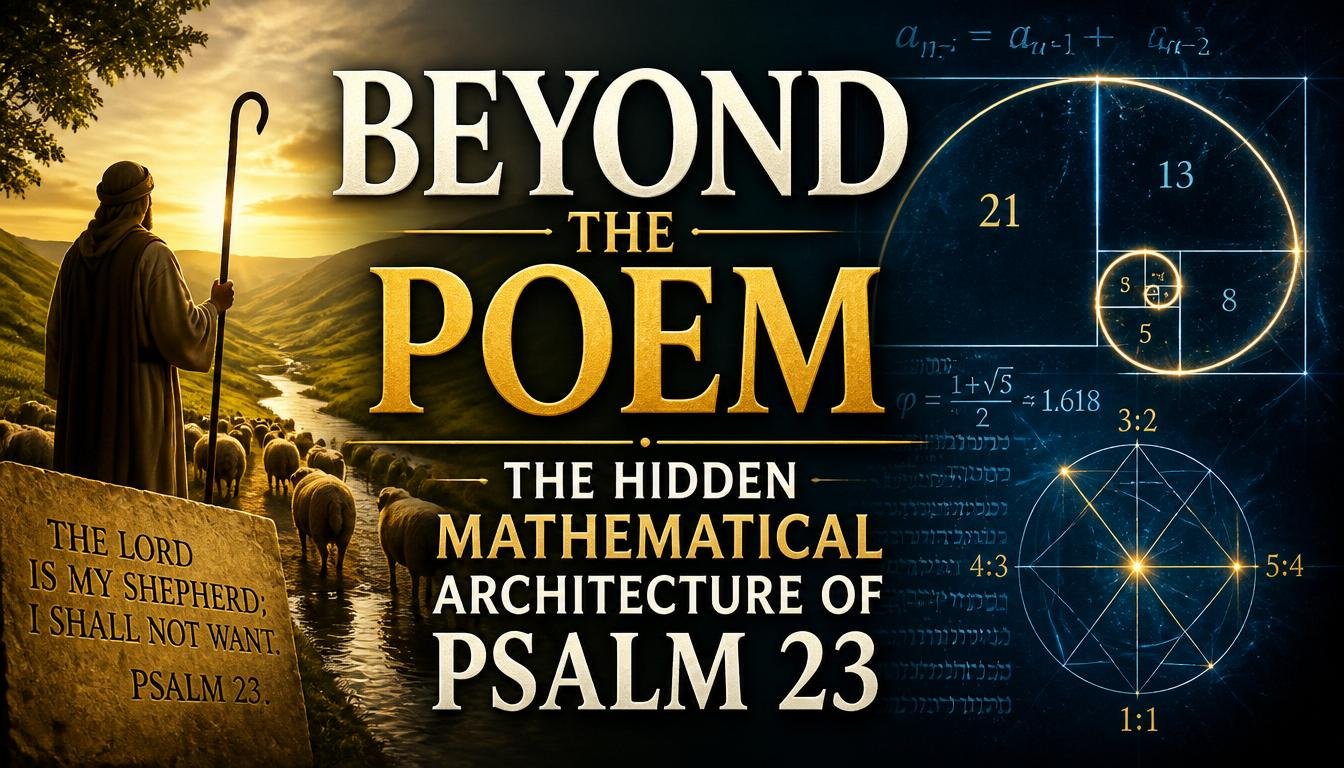
Beyond the Poem: The Hidden Mathematical Architecture of Psalm 23
Psalm 23 is arguably the most recognisable fragment of
literature in the human canon. To the casual reader, it offers a
lyrical sanctuary of comfort; to the theologian, it stands as a
monumental confession of faith. Yet, for those who peer
beneath the surface of the Masoretic text, a more profound
Reality emerges. There exists a sophisticated mathematical
construct—a “Shepherd’s Code”—woven into the original
Hebrew. This hidden architecture suggests that the spiritual
The peace the Psalm provides is not merely a subjective
psychological effect, but is crystallised in a universal precision
that connects the human soul to the primordial laws of the
cosmos.
The Language where Letters are Numbers
To the initiate, the Hebrew alphabet is not a mere set of
phonetic markers, but a periodic table of divine elements. In
In this sacred tongue, every character is simultaneously a
numeral, meaning that the text of Psalm 23 is as much a
ledger as it is a poem. This “Shepherd’s Code” is deciphered
through Hebrew Gematria, utilising both Standard Gematria
(the sum of letter values) and Ordinal Values (the placement of the letter within the 22-character alphabet).
Beyond the Poem: The Hidden Mathematical Architecture of Psalm 23
Psalm 23 is arguably the most recognizable fragment of literature in the human canon. To the casual reader, it offers a lyrical sanctuary of comfort; to the theologian, it stands as a monumental confession of faith. Yet, for those who peer beneath the surface of the Masoretic text, a more profound reality emerges. There exists a sophisticated mathematical construct—a “Shepherd’s Code”—woven into the original Hebrew. This hidden architecture suggests that the spiritual peace the Psalm provides is not merely a subjective psychological effect, but is crystallized in a universal precision that connects the human soul to the primordial laws of the cosmos.
The Language where Letters are Numbers
To the initiate, the Hebrew alphabet is not a mere set of phonetic markers, but a periodic table of divine elements. In this sacred tongue, every character is simultaneously a numeral, meaning that the text of Psalm 23 is as much a ledger as it is a poem. This “Shepherd’s Code” is deciphered through Hebrew Gematria, utilizing both Standard Gematria (the sum of letter values) and Ordinal Values (the placement of the letter within the 22-character alphabet).
At the heart of this study lies the concept of Mispar ha-Panim, or “Inner Math.” Kabbalistic tradition posits that when two distinct phrases share a numerical value, they share a spiritual essence. This is rooted in the foundational belief that the Creator engineered the universe through Sefer, Sapher, and Sippur—Number, Writing, and Speech. In this worldview, mathematics is the objective “language of God,” providing an axiomatic foundation beneath the shifting tides of human emotion.
The Divine DNA (The Number 26)
The numerical signature of the Divine Name acts as the metaphysical anchor for the entire composition. The Tetragrammaton (YHVH), the unpronounceable four-letter name of God, possesses a numerical value of 26 (10 + 5 + 6 + 5). This is not a random sum; it is the “DNA” of the biblical text, appearing as a structural constant that dictates everything from the dimensions of the Tabernacle to the frequency of divine intervention.
The opening phrase, Adonai Roi (יהוה רעי—“The Lord is my Shepherd”), pairs the value of 26 with 280 (the value of “Shepherd”). This union is more than a title; it represents a specific spiritual frequency. By anchoring the poem in the number 26, the text balances the Sephirot of Chesed (Mercy) and Gevurah (Strength), creating a harmonic resonance that allows the reader to navigate “the valley of the shadow” without fear.
“The number 26 is the ‘DNA’ of the Bible, appearing as a structural constant in the dimensions of the Tabernacle and the frequency of the Divine Name throughout the text.”
The Mathematical “Hinge” of the Soul
The structural integrity of Psalm 23 is revealed in its boundaries: the original Hebrew consists of exactly 57 words. Within this closed system, there is a deliberate pivot point that shifts the reader’s relationship with the Divine. The first half of the Psalm utilizes the third person, talking about God (“He leads me,” “He restores my soul”), but the second half shifts to the second person, talking to God (“You are with me”).
This transition occurs at the precise mathematical center of the work, the phrase Ki Atah Imadi (“For You are with me”). This central “hinge” consists of exactly seven letters. In the esoteric tradition, the number seven signifies completion and the sanctity of the Sabbath. By placing this seven-letter phrase at the core of the 57 words, the Architect of the text suggests that the transition from objective observation to personal intimacy is the ultimate point of spiritual rest. It is a mathematical initiation from a God who is “out there” to a Presence that is “here.”
Geometric Alignment with Creation
The “Shepherd’s Code” is not isolated; it is geometrically aligned with the very beginning of the biblical record. Through the Law of Prime Numbers, we find that the total gematria of key verses in the Psalm results in multiples of 37 and 73.
These numbers are the fundamental “factors” of creation. The first verse of the Bible (Genesis 1:1) has a total numerical value of 2701, which is the product of exactly 37 and 73. These two numbers form a unique Hexagonal/Star geometry in mathematical theory. By integrating these same factors into the structure of Psalm 23, the text posits that the same “Architect” who coded the origin of the universe also coded the promise of “no want” (v. 1). The peace described in the poem is thus shown to be woven into the very fabric of reality.
The Biological Synchronization of ’23’
While the division of the Bible into numbered chapters was a later historical addition, the “Shepherd’s Code” suggests a divine synchronization regarding the number 23 itself. This number appears to bridge the gap between ancient scripture and the physical reality of the human vessel.
Biologically, the human blueprint is contained within 23 pairs of chromosomes. Numerologically, 23 is associated with the “Royal Star of the Lion,” specifically the star Regulus, which has historically symbolized a protective influence and royal grace. This suggests that the 23rd Psalm is not merely a collection of words, but a frequency that resonates with the biological and celestial structures governing human life, providing a shield of protection that is written into our very cells.
Conclusion: The Language of the Architect
Psalm 23 functions as a dual masterpiece: it is a subjective poem of profound comfort and an objective mathematical map. By examining the Gematria and structural geometry of the original Hebrew, we encounter a text that is precisely engineered to reflect universal constants and biological realities.
If the most famous words of comfort in history are built upon a foundation of mathematical certainty, what does that suggest about the design of our own lives? Perhaps our paths are not as random as they seem, but are being guided by a code that is as precise as it is merciful.
https://biblenumbers101.com/is-the-bible-really-written-in-math-5/
https://divinetruthofnumbers.com/7-ancient-hebrew-names-of-god/