Aleph to Tav. The Hidden Order of Hebrew Acrostics in the Psalms | Psalm 119
Explore how the 22-letter Hebrew alphabet shapes biblical acrostic Psalms. Learn why Psalm 119 has 176 verses, why some letters are missing, and how Aleph to Tav reveals the completeness of God’s Word.
The Hebrew alphabet has 22 letters.
These letters form the foundation of canonical acrostic Psalms found in the Bible.
In these Psalms, verses or sections begin with successive Hebrew letters.
This structure is called an alphabetical or canonical acrostic.
The purpose is clear.
Beauty. Order. Memory. Meaning.
Why Acrostics Matter?
Acrostic Psalms serve two main purposes.
They display poetic structure.
They help memorisation in oral tradition.
More than style, they communicate theology.
From Aleph to Tav, the message points to completeness.
God’s Word covers everything. Like A to Z.
Psalm 119. The Perfect Word-Centred Acrostic
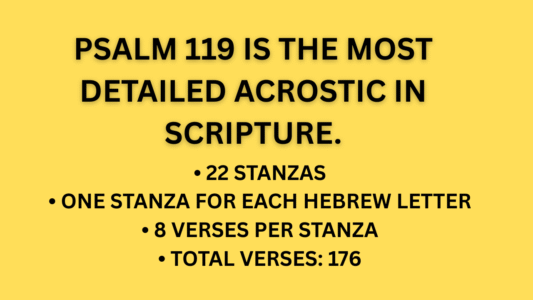
Psalm 119 is the most detailed acrostic in Scripture.
Its structure is precise.
• 22 stanzas
• One stanza for each Hebrew letter
• 8 verses per stanza
• Total verses: 176
Every verse in a stanza begins with the same letter.
This order reflects perfection and completeness.
The theme is singular.
Love for God’s Word.
Devotion to Torah, statutes, and commandments.
Key Letter Sections in Psalm 119
A list of all 22 Hebrew alphabet sections in Psalm 119,
Psalm 119 is structured around the 22 Hebrew letters.
Each letter governs 8 verses.
Total verses: 176.
Key Letter Sections in Psalm 119
- Aleph (א)
Foundation of faith.
Blessed are those who walk in God’s law. - Beth (ב)
Purity of life through God’s Word.
A young person keeps the way clean by taking heed to the Word. - Gimel (ג)
Life as a stranger on earth.
A longing for God’s commandments. - Daleth (ד)
Revival from clinging to the dust.
Life restored through the Word. - He (ה)
A repeated prayer.
Teach me the way of Your statutes. - Vav (ו)
Steadfast obedience.
A life without shame before God. - Zayin (ז)
Comfort during affliction.
God’s Word gives hope and strength. - Heth (ח)
God as the psalmist’s portion.
Commitment to keep His words. - Teth (ט)
Affliction as a teacher.
Suffering leads to obedience and wisdom. - Yod (י)
God as Creator.
You made me and fashioned me. - Kaph (כ)
A weary soul waiting for hope.
Trust placed in God’s promise. - Lamed (ל)
God’s Word is settled forever in heaven.
His faithfulness continues through all generations. - Mem (מ)
Wisdom through meditation on God’s law.
God’s commandments give greater understanding than teachers. - Nun (נ)
God’s Word as lamp and light.
Guidance for the path of life. - Samekh (ס)
Hatred of vain thoughts.
Love for God’s law. - Ayin (ע)
A plea for justice.
People have made void God’s law. - Pe (פ)
The entrance of God’s Word brings light.
Understanding for the simple. - Tsade (צ)
God’s righteousness.
His judgments are upright and true. - Qoph (ק)
Crying out with the whole heart.
Hope placed in God’s Word. - Resh (ר)
The sum of God’s Word is truth.
Every judgment is everlasting. - Shin (ש)
Great peace for those who love God’s law.
Nothing causes them to stumble. - Tav (ת)
A lost sheep seeking the Shepherd.
A final prayer to be found by God.
This Aleph-to-Tav structure shows the completeness and perfection of God’s Word, from beginning to end.
1. Aleph. Foundation and faith.
2. Beth. Purity through God’s Word.
3. Gimel. Living as a stranger on earth.
4. Daleth. Revival from clinging to the dust.
5. He. A repeated cry. Teach me Your statutes.
6. Vav (ו) Steadfast obedience. A life without shame before God.
7. Zayin. Comfort in affliction through the Word.
8. Heth. God as the psalmist’s portion.
9. Teth (ט) Affliction as a teacher. Suffering leads to obedience and wisdom.
10. Yod. God as Creator who formed me.
11. Kaph (כ) A weary soul waiting for hope. Trust placed in God’s promise.
12. Lamed (ל) God’s Word is settled forever in heaven. His faithfulness continues through all generations.
13. Mem. Wisdom gained through meditation on God’s law.
14. Nun. God’s Word as lamp and light, verses 105–112.
15. Samekh. Hatred of vain thoughts. Love for the law.
16. Ayin. A plea because people void God’s law.
17. Pe (פ) The entrance of God’s Word brings light. Understanding for the simple.
18. Tsade (צ) God’s righteousness. His judgments are upright and true.
19. Qoph. Crying out with the whole heart.
20. Resh. The sum of God’s Word is truth.
21. Shin. Great peace for those who love the law.
22. Tav. The psalmist as a lost sheep seeking God.
Broken and Incomplete Acrostics
Not all acrostics are perfect.
This is intentional.
Psalm 25 follows the alphabet but misses one letter.
The missing letter is Vav, which means hook or connection.
The final verse steps outside the pattern with a prayer for redemption.
Psalm 34 also skips Vav.
Both Psalms suggest a broken connection caused by human weakness.
Jewish commentators like Rashi explain this clearly.
Human prayers are limited.
Only God’s Word is perfect.
Linked and Irregular Acrostics
Psalm 9 and Psalm 10 together form one incomplete acrostic.
Individually, they look irregular.
Together, they reveal a hidden structure.
Other Acrostic Patterns
Psalm 37 uses two verses per Hebrew letter.
Psalm 111 and Psalm 112 use half-verses. Each poetic line begins with a new letter.
Psalm 112 is titled The Blessed Man.
Psalm 145 is an alphabetical hymn of praise.
In the Masoretic Text, one letter is missing. Nun.
That missing verse appears in the Dead Sea Scrolls and the Septuagint.
Acrostics Beyond the Psalms
The first four chapters of Lamentations use acrostics.
In some chapters, Ayin and Pe swap order.
This reflects grief and disruption after Jerusalem’s fall.
Proverbs also contains an acrostic.
Proverbs 31:10–31 describes the Woman of Valor using the Hebrew alphabet.
The Textual Foundation
The standard Hebrew Bible text is known as the Masoretic Text.
It preserves these structures with precision.
Theological Meaning
Acrostic Psalms teach one core truth.
God’s Word is complete.
Human devotion strives toward that perfection.
Aleph to Tav frames divine truth.
From beginning to end.
From creation to restoration.
FAQ’S
- How many letters comprise the Hebrew alphabet used in canonical acrostic Psalms?
ANSWER: 22
- What term is used for Psalms where each verse or section begins with a successive letter of the Hebrew alphabet?
ANSWER: Alphabetical (or canonical acrostic) psalms.
- What is the primary poetic structure of Psalm 119?
ANSWER: It has 22 stanzas, with each 8-verse stanza beginning with a successive letter of the Hebrew alphabet.
- What is the total number of verses in Psalm 119?
ANSWER: 176 verses ($22 \text{ stanzas} \times 8 \text{ verses per stanza}$).
- Symbolically, what does an acrostic from $Aleph$ to $Tav$ represent regarding God’s Word?
ANSWER: The completeness or totality of God’s Word (similar to “A to Z”).
- Besides poetic beauty, what was a practical purpose for the acrostic format in the Psalms?
ANSWER: To help with memorisation.
- Which two Psalms are considered to form a single, albeit irregular and incomplete, acrostic together?
ANSWER: Psalm 9 and Psalm 10.
- What is the specific acrostic pattern of Psalm 25?
ANSWER: Each verse begins with a successive Hebrew letter, though it is slightly incomplete.
- Which Hebrew letter is notably missing from the acrostic sequence in Psalm 25?
ANSWER: The letter $Vav$ (ו).
- How does the final verse (v. 22) of Psalm 25 deviate from the acrostic structure?
ANSWER: It is an extra prayer for redemption that does not follow the alphabetical sequence.
- Which Psalm is characterised as a Messianic psalm but does not follow an alphabetic acrostic structure?
ANSWER: Psalm 22.
- What is the acrostic structure of Psalm 37?
ANSWER: Each section (or double verse) begins with a successive Hebrew letter.
- How do the acrostic patterns of Psalm 111 and Psalm 112 differ from most other acrostic Psalms?
ANSWER: Every half-verse (poetic line) begins with a successive Hebrew letter.
- Which letter is missing from Psalm 145 in the standard Masoretic Text?
ANSWER: The letter $Nun$ (נ).
- Where has the missing $Nun$ verse of Psalm 145 been discovered by scholars?
ANSWER: In the Dead Sea Scrolls and the Septuagint.
- According to the provided material, which two Psalms both skip the letter $Vav$ (ו) in their acrostic order?
ANSWER: Psalm 25 and Psalm 34.
- What does the Hebrew letter $Vav$ (ו) literally mean?
ANSWER: Hook or connection.
- What might the intentional absence of the letter $Vav$ in certain acrostic Psalms symbolise?
ANSWER: A “broken connection” caused by human sin or imperfection.
- Which biblical book contains acrostics in its first four chapters?
ANSWER: Lamentations.
- In the book of Lamentations, which two letters occasionally swap their usual alphabetical order?
ANSWER: “Ayin” (ע) and “Pe” (פ).
- Where in the book of Proverbs can an alphabetic acrostic be found?
ANSWER: Proverbs 31:10–31 (the description of the “Woman of Valor”).
- What is the general theme of Psalm 119?
ANSWER: Devotion to and love for God’s Word (Torah, statutes, and commandments).
- In Psalm 119, which letter begins the section for verses 105–112?
ANSWER: $Nun$ (נ).
- The famous verse “Thy word is a lamp unto my feet, and a light unto my path” is found under which acrostic letter in Psalm 119?
ANSWER: $Nun$ (נ).
- Which Hebrew letter represents the 22nd and final stanza of Psalm 119?
ANSWER: $Tav$ (ת).
- What is the primary theme of the $Teth$ (ט) section (verses 65–72) in Psalm 119?
ANSWER: How affliction can be a blessing that teaches obedience to God’s statutes.
- In the $Lamed$ (ל) section of Psalm 119, what is described as being “settled in heaven” forever?
ANSWER: God’s Word.
- What is the core message of the $Shin$ (ש) section in Psalm 119 (verses 161–168)?
ANSWER: Great peace belongs to those who love God’s law.
- According to Jewish commentators like Rashi, why are some acrostics “broken” or incomplete?
ANSWER: To show that human prayers are limited and only God’s Word is perfect.
- What is the first letter of the Hebrew alphabet?
ANSWER: Aleph (א).
- What is the final letter of the Hebrew alphabet?
ANSWER: $Tav$ (ת).
- The section of Psalm 119 beginning with $Beth$ (ב) focuses on what theme?
ANSWER: Maintaining purity by taking heed to God’s Word.
- Which section of Psalm 119 emphasises the Psalmist living as a “stranger in the earth”?
ANSWER: The “Gimel” (ג) section (verses 17–24).
- In Psalm 119, the $Daleth$ (ד) section focuses on revival from what state?
ANSWER: From “cleaving to the dust.”
- What is the recurring request in the $He$ (ה) section of Psalm 119 (verses 33–40)?
ANSWER: “Teach me, O LORD, the way of Thy statutes.”
- In the $Zayin$ (ז) section of Psalm 119, where does the Psalmist find comfort during affliction?
ANSWER: In God’s Word.
- What does the Psalmist declare God is to him in the $Heth$ (ח) section (verses 57–64)?
ANSWER: His “portion.”
- The $Yod$ (י) section of Psalm 119 acknowledges God as what to the individual?
ANSWER: The Creator who “made me and fashioned me.”
- In the $Mem$ (מ) section of Psalm 119, what does the Psalmist claim gives him more wisdom than his teachers?
ANSWER: God’s commandments and meditation on His law.
- In the $Pe$ (פ) section of Psalm 119, what does the entrance of God’s words provide to the “simple”?
ANSWER: Light and understanding.
- The $Tsade$ (צ) section of Psalm 119 focuses on what attribute of God?
ANSWER: His righteousness (“Tsaddi” means righteous).
- Which acrostic Psalm uses exactly two verses for every Hebrew letter?
ANSWER: Psalm 37.
- Which acrostic Psalm includes the verse “I will bless the LORD at all times”?
ANSWER: Psalm 34.
- Which Psalm is specifically titled “The Blessed Man” and uses a half-verse acrostic structure?
ANSWER: Psalm 112.
- Which Psalm is described as a “Word-Centred Acrostic”?
ANSWER: Psalm 119.
- In the $Samekh$ (ס) section of Psalm 119, what does the Psalmist say he hates?
ANSWER: Vain thoughts (while loving God’s law).
- The $Ayin$ (ע) section of Psalm 119 includes a plea for God to work because of what situation?
ANSWER: People have “made void” God’s law.
- In the $Qoph$ (ק) section of Psalm 119, the Psalmist describes crying out with what part of himself?
ANSWER: His whole heart.
- The $Resh$ (ר) section of Psalm 119 concludes that the “sum” of God’s word is what?
ANSWER: TRUTH
- How does the final verse of Psalm 119 ($Tav$ section) describe the Psalmist’s state?
ANSWER: As a lost sheep seeking to be found by God.
- Which acrostic Psalm is an alphabetical hymn of praise and is missing the letter $Nun$?
ANSWER: Psalm 145.
- Is Psalm 25 considered a “perfect” or “almost complete” acrostic?
ANSWER: Almost complete (missing “Vav”).
- What is the structural difference between the acrostics in Psalm 111 and Psalm 119?
ANSWER: Psalm 111 changes letters every half-verse; Psalm 119 changes letters every 8 verses.
- In the context of acrostic Psalms, what is the Masoretic Text (MT)?
ANSWER: The standard Hebrew Bible text.
- What theological concept is reinforced by Psalm 119’s
perfect acrostic structure?ANSWER: The perfection and completeness of the Torah (God’s Law).
- What theological concept is reinforced by Psalm 119’s
perfect acrostic structure?ANSWER: The perfection and completeness of the Torah (God’s Law).